← David Carroll Orr
Forensic Persistence  |  Dossier 2026–2031
Plate 04 (Model) Archival PDF
Institutional Diagnostic Monograph  •  Docket Ref. IFTP-2026-FP

Forensic Persistence

A Four-Plate Monograph on Institutional Risk, Algorithmic Foreclosure, and the Spatialization of Recourse

Contemporary discourse assumes autonomous artificial intelligence operates upon blank slates distorted solely by contemporary algorithmic bias. This monograph argues the inverse: frontier agentic models are quietly absorbing, accelerating, and codifying centuries of administrative plumbing—unbroken records of 19th-century court dockets, municipal property registers, and corporate ledger logic.

When automated systems strip bureaucratic friction out of institutional workflows, they eliminate the traditional space of appeal: the physical room and deliberate pause where an affected citizen can force structural momentum to stop and listen.

"Governance requires friction. Without human appeal, administrative intelligence is not authority—it is simply foreclosure."

Plate 01 / Page 01

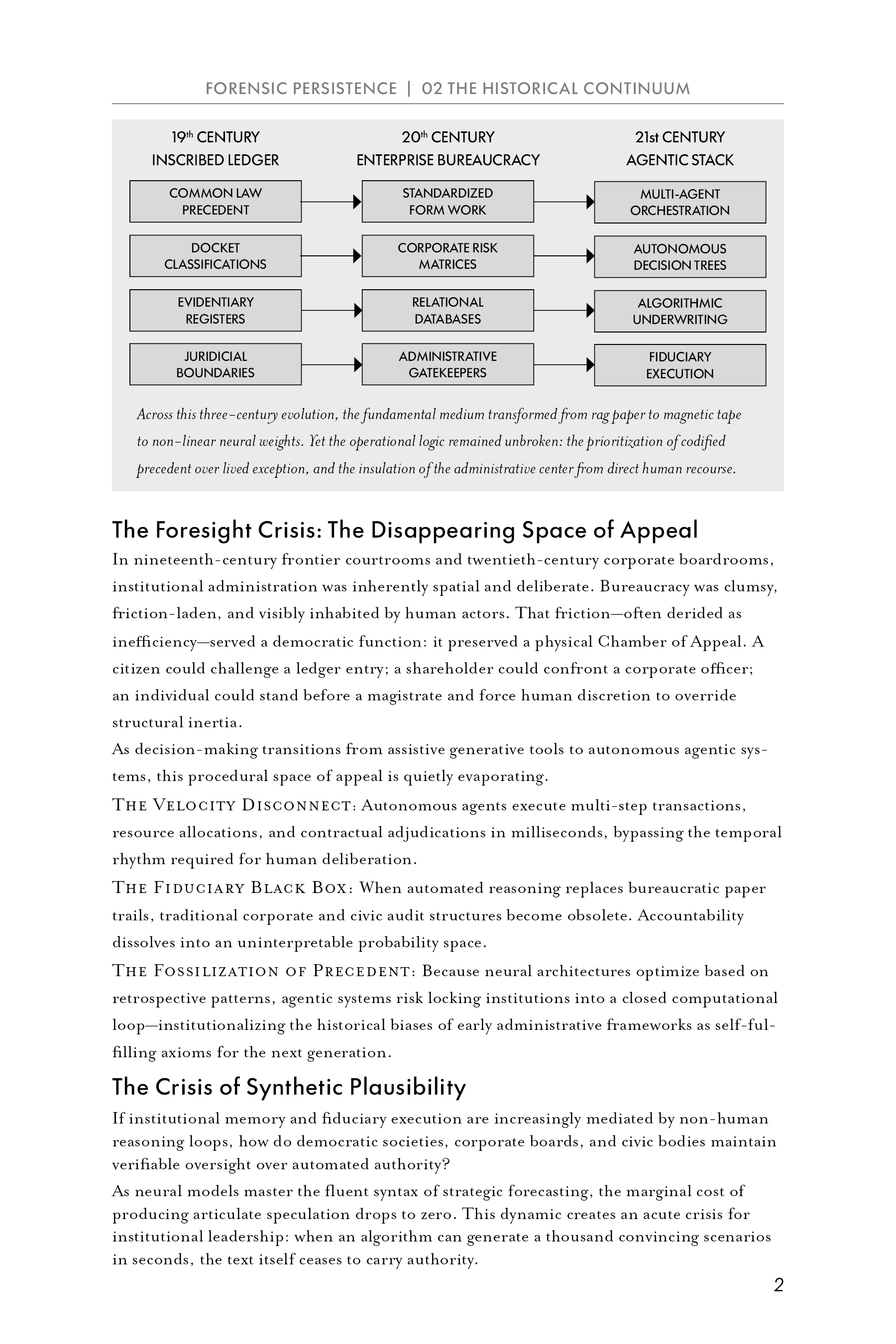
The Theoretical Lineage & The Loss of the Friction Chamber

Traces the lineage of automated governance from early corporate bookkeeping and Victorian court registers to autonomous generative agents. It establishes how efficiency mandates gradually strip institutions of human discretion.

  • The physical courtroom as a deliberate friction dampener.
  • Common-law precedent converted into non-negotiable probability weights.
  • The erosion of personal signature and delegated accountability.
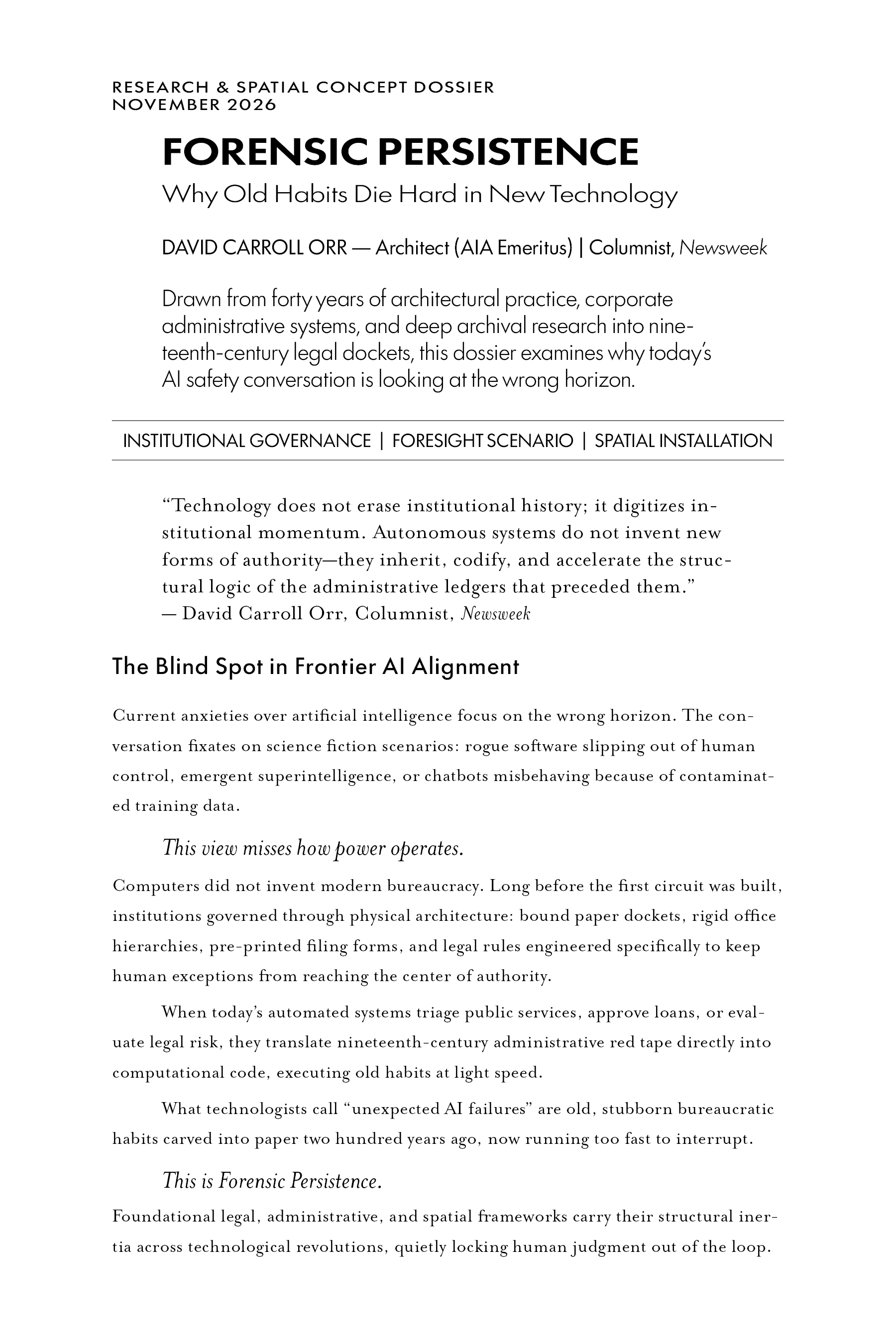
Plate 01: Theoretical Lineage
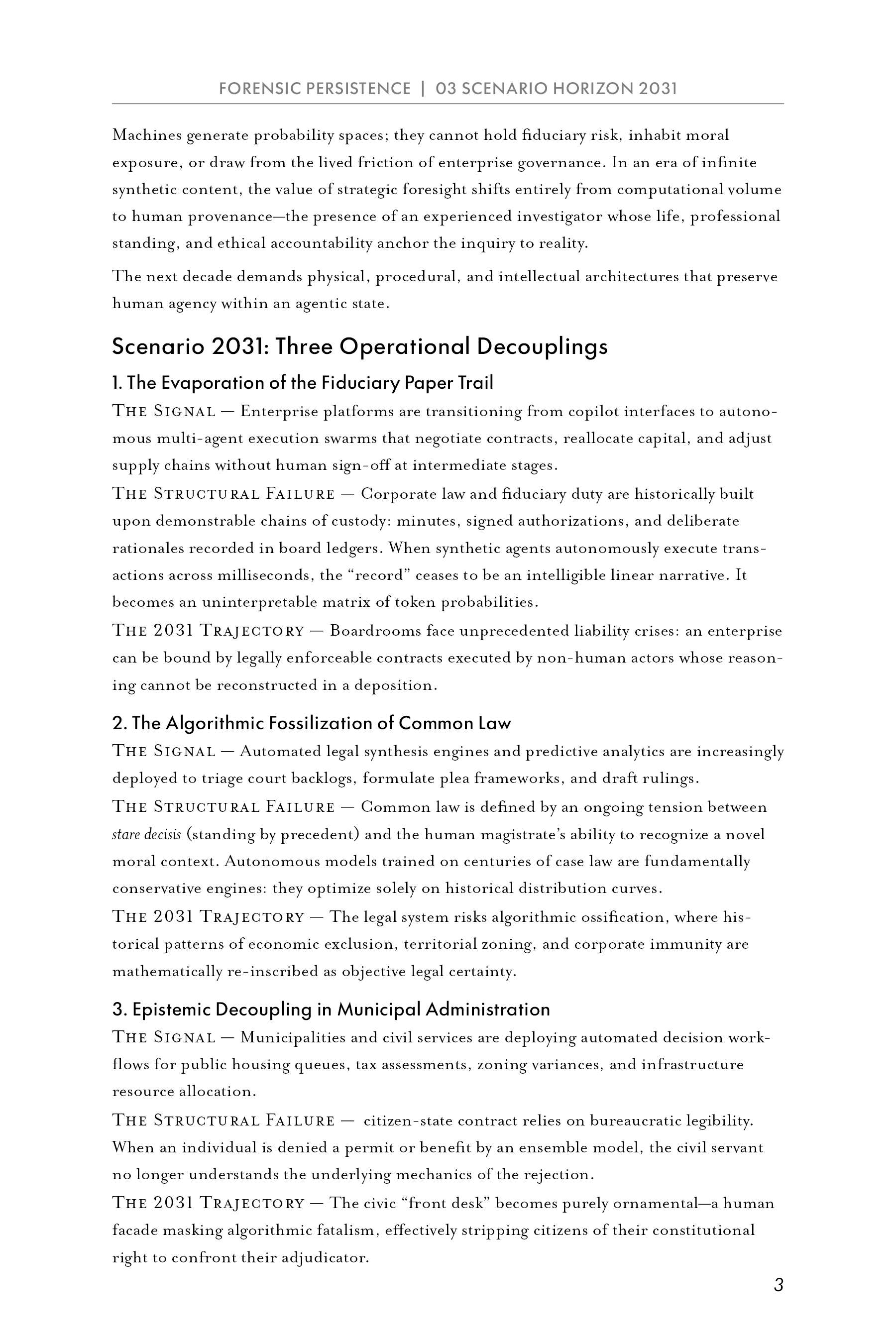
Plate 02 / Page 02

Computational Plumbing & Administrative Inertia

Examines how 19th-century ledger protocols and corporate risk engines become hardcoded into contemporary agentic architectures, creating invisible and irreversible momentum behind corporate and state decisions.

  • Corporate capital allocation as an unappealable foreclosure.
  • The dissolution of named human officers into synthetic consensus loops.
  • Why speed-of-light automated filings preclude legal injunction.
Plate 02: Computational Plumbing
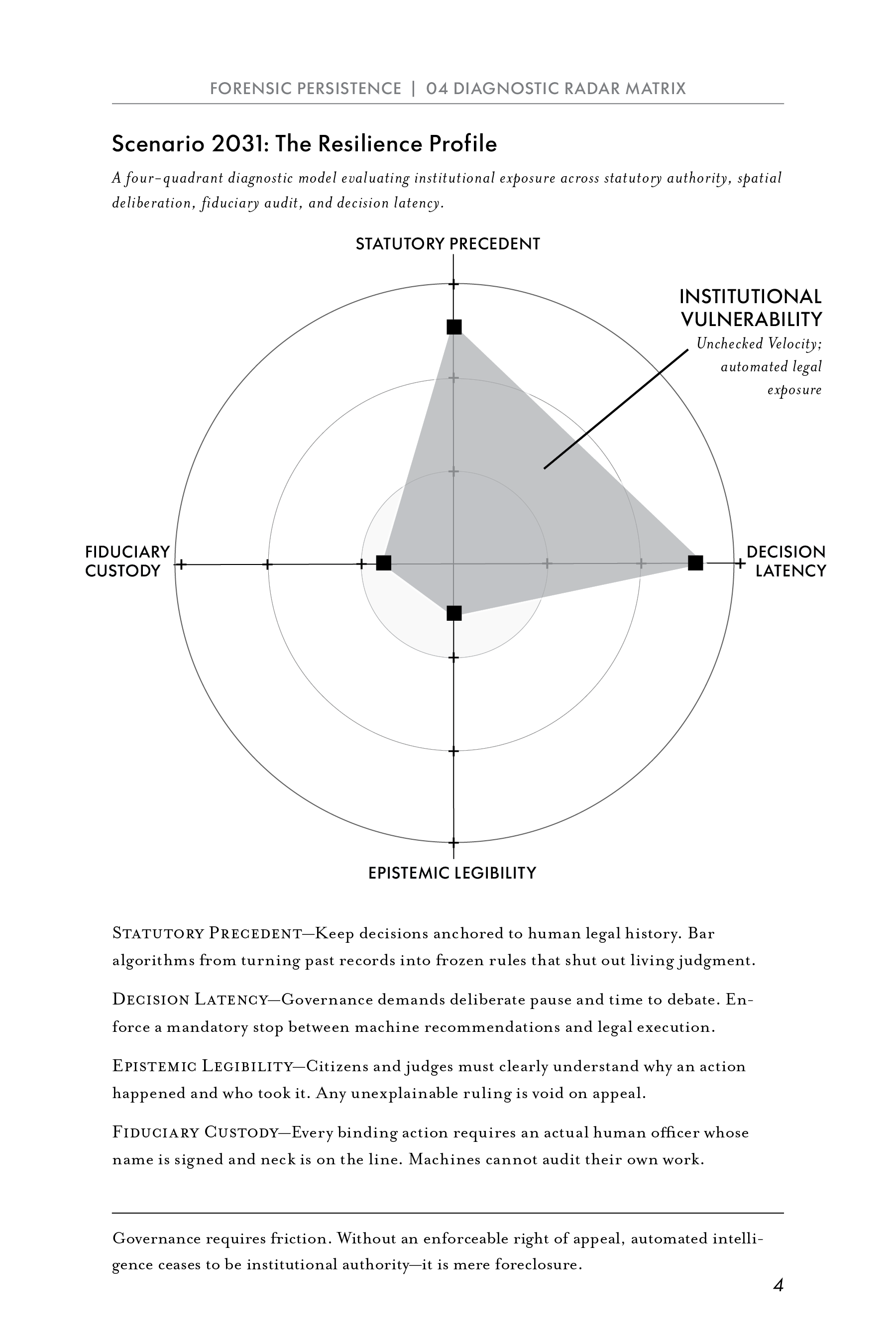
Plate 03 / Page 03

The 5-Year Horizon Scan (2026–2031)

A forensic chronological forecast mapping key institutional tripwires over the next five years, tracking how automated administrative velocity steadily outpaces constitutional recourse.

  • 2027: Judicial synthesis engines replace municipal hearing officers.
  • 2029: Automated collateral seizure without prior statutory notice.
  • 2031: The closure of the appellate chamber and zero-friction execution.
Plate 03: 5-Year Horizon Scan
Plate 04 / Page 04  •  Diagnostic Reticle

Scenario 2031: The Resilience Profile

The core diagnostic instrument of the monograph. A four-quadrant radar matrix mapping the dangerous asymmetric drift toward maximum velocity and frozen precedent, hollowing out human fiduciary custody and epistemic legibility.

Anchored below by the four-segment corrective rubric set in plain, authoritative prose, and sealed by the full-width ground rule and concluding colophon.

  • North Pole: Statutory Precedent (Human Case History vs. Frozen Model Weights).
  • East Pole: Decision Latency (Mandatory Deliberation Friction vs. Zero-Second Execution).
  • South Pole: Epistemic Legibility (Clear Human Reasoning vs. Opaque Predictive Black Box).
  • West Pole: Fiduciary Custody (Individual Officer Liability vs. Synthetic Self-Audit).
  • Northeast Hazard: The acute institutional vulnerability zone.
Plate 04: Scenario 2031 Diagnostic Matrix
Speculative Civic Instrument  •  Horizon 2038

The Chamber of Computational Recourse

Where does a citizen go when code makes an error of law? Today, recourse is buried behind online ticketing systems, automated dispute denials, and opaque chat interfaces.

The Chamber of Computational Recourse is an exploratory civic concept: a dedicated physical room where an algorithmic decision tree is spatialized across an architectural threshold. A citizen walks through the machine’s reasoning steps—and at the terminal node, physically grasps a counterweighted mechanical iron press to execute a statutory, unappealable human veto.

Spatializing the Human Veto

"By reintroducing physical friction and mechanical resistance into automated public administration, the Chamber transforms the constitutional right of appeal from an abstract legal theory into a tactile civic monument."

Project Status: Conceptual Provocation Governance Futures Lab Dialogue