Shannon Line Precursors
Two theories for the ancestral origin of Thomas Shannon, Sr.
Some researchers believe that Thomas Shannon, Sr., below, was the son of a Thomas Shannon, b. 1686, Londonderry, Ireland,(49) d. Apr. 1737, Sadsbury, Chester, Pennsylvania.(50)
Two men, each born in Ireland, eventually located near each other on different sides of the Savannah River — Thomas on the Georgia side, William on the South Carolina side. Their relationship as brother is hypothesized, but unproved.
- Thomas Shannon, Sr.
- William "Long Canes" Shannon *
Theory first developed in 2024 by Stanley Shannon and shared on this blog: Genealogy Rant: Thomas Shannon (1730-1794) and Descendants, as accessed Jan. 24, 2026:
In summary:
- Birth of a son, Thomas Shannon, in London, 1730, to Alexander Shannon, grocer, and Ann Ansell, who is christened in an Anglican church.
- A Thomas Shannon establishes a family in colonial North America beginning in the mid-1750s, marrying and christening children in an Anglican church in Delaware, with later generations marrying into Anglican, English families. Possibly the same Thomas who migrates to Georgia in 1773.
- The name Alexander as a middle name is recorded in several descendent family lines.
- Genetic testing of the paternal line indicates a strong association with the population in and around London, England corresponding to a well-documented record of intermarriage with families from that same region.
In Argument:
I spent many long years looking for evidence of our lineage in Northern Ireland without success. However, we do find earlier generations of Shannons living in London as well-placed merchants apparently integrated comfortably into the local society and economy who do seem to match what we know of our immigrant ancestor, Thomas.
A man named Daniel Shannon worked as a silk dyer in London in the early 18th century. He was married in 1697 to Margaret Brown and had two sons, John and Thomas, both christened in a local Anglican church (Church of England).
A generation later, a grocer named Alexander Shannon married to Ann Ansell had two sons, Thomas and John also christened in a local Anglican church. Thomas was christened in 1730. These families conform to exactly the basic social context we find Thomas in during his lifetime in North America other than the obvious change from very urban to very rural.
Silk dyers and grocers were not trivial positions in the era from late 17th to early 18th century. This was the very beginning of modern consumerism, at the very epicenter of the British Empire in its early expansion period. These would have been solidly middle class professions, which would indicate a family background of some degree of wealth. At that time individuals had to buy their way into these professions, and that required some sort of investment on the part of a family.
The names Daniel and Alexander are probably middle names. Christian names in English tradition at the time were usually just the first name, but an unofficial middle name, reflecting some family association of some kind, could also be used by someone for various reasons. If your Christian (first) name was John and you lived in a more densely populated area, you might go by a middle name, Alexander say, to avoid confusion in the local records.
The name Daniel doesn’t appear in the early generations of our family in North America, but the name Alexander does appear in later generations usually as a middle name. There is a John Alexander Shannon, as well as a daughter named Alexandria in the Tippah County branches and a William Alexander Shannon among Aaron (1796-1865) Shannon’s children. One of the other Shannon branches related to ours by YDNA also has an Alexander.
Proving any of this beyond a reasonable doubt will probably remain impossible. But the available evidence provides a compelling argument that this is the family our Thomas was from. Church affiliation is significant because it indicates a very different cultural association from most Scots Irish elsewhere. In both places, we have a Shannon family with common names and age ranges operating within the same atypical social context. Thomas was born into an English mercantile social context and his descendants remained connected to that population for generations as they marched across the Southern frontier.
Daniel Shannon left a record of filing for bankruptcy. Nothing more has been found on him so far. There is nothing that connects him to Alexander other than the commonality of names from christenings – John, Thomas and then Thomas, John. These are common names but appear in precisely the pattern we would expect of a family relationship. Daniel’s son John might have been ‘John Alexander’ and uses his middle name as an adult in business to avoid being confused with other John Shannons around.
Since London was the hub of the growing British Empire, it was also the beating heart of international mercantilism. Alexander Shannon was a grocer at the very docks on the Thames river where most of this activity was concentrated. This must have been a quite lucrative location, the very delivery room for the birth of modern commercialism.
At some point, however, Alexander made an investment which did not work out as he planned and he was left with a debt he could not repay. His name is mentioned in the paper of record in relation to debtors prison. What happened afterwards is not known. The name Alexander Shannon does not appear again in that area afterwards. But it isn’t difficult to imagine any number of subsequent scenarios that might have resulted in his son, Thomas, ending up in Delaware, then on to the Virginia colonial frontier and finally into Georgia.
The conditions leading to Thomas’ migration to North America could have been an indenture, or it could have been as an agent for some larger mercantile association of some kind. By whatever process, he ends up as a planter at a location in Georgia with easy access to international navigation, on the Savannah river near a fortified location.
Was Thomas on the production end of a textile operation? Supplying indigo or cotton to a market operation would explain an investment in his unique migratory pattern. How much about agriculture in a sub-tropical frontier region could a man such as Thomas have known about? He is obviously working from knowledge acquired from contacts, not from his own personal experience. Thomas almost certainly was a member of a wide network of interrelated people. Even indentured servants could have wealthy contacts they could take advantage of once their indenture had been served.
Frankly, I don’t believe most of the people who pushed out to such frontiers were doing so entirely of their own accord. I think nearly all of the first generation of settlers on colonial frontiers had investors and assistance from a system organized to feed produce into a growing global economy. They were essentially paid to go somewhere and once there they were met by someone who taught them the basics of growing the new crops they were expected to produce. No sane person approaching middle age with a large family would have invested their entire fortune into such a dangerous situation in an entirely alien and foreign part of the world on wild eyed speculation. There was clearly some kind of extensive well-funded plan behind all of it. Wealthy people wanted the frontier developed and were applying great economic pressure on the lower classes to achieve that goal for them.
Historic Analysis:
- Documentation for the family of Thomas Shannon (1730-1794) line in the American South indicates a much higher level of integration into an English cultural context than a Scots-Irish one, conforming to the genetic data discussed above. The marriage records we have are all to families of Southern colonial English descent – Carey (not proven), Perkins, Cockerham, Chambers, Rowell, Baugh, are all well documented back to early colonial settlement in Maryland, Virginia and the Carolinas.
- Genetics indicate a concentration of ancestry for this lineage around the region of London, England.
- The question is when did this pattern begin? It seems odd that a man with a common Scots family background would immigrate to the colonies and immediately become more associated with English colonists and their cultural community than with the many Scots-Irish communities around. When did our Shannon lineage become so English centric culturally?
- An understanding of the historic context such families were immersed in is important. There was a large movement of population from the Scottish Lowlands into Northern Ireland in the 16th and 17th centuries and then on into North American in the 18th century, along with all the associated religious and political strife involved. This was the historic origins of the well documented protestant Scots-Irish migration that played such an important role in subsequent American history.
- However, a somewhat smaller migration of members of the same Scots population southward into England, particular London, occurred at about the same time but went largely ignored historically. Many of these people went into military, legal or clerical, careers. Most, however, were members of the mercantile class taking advantage of the sudden huge influx of global commodities pouring into Britain and Europe as world trade began expanding exponentially following in the wake of the age of discovery and early colonial trade. This was generally the period when the Scottish Stewart kings assumed the English throne, leading to civil wars and revolutions and finally the act of union bringing Scotland and England together under a common ruling authority in 1707.
- Those who found occupations as various kinds of merchants during this time were typically the younger sons of gentry class families. The economy did not immediately allow for the upward mobility of the lower classes into a middle class lifestyle. That was still a few generations away. But it did allow for increased opportunities for the younger members of landed families with the resources to take advantage of it.
- Most occupations began with apprenticeships which had to be paid for. Indentured servitude was also a way to become employed in some mercantile trade, but typically at a lower, working, level. Some occupations required more wealth to buy into than others. So, the kind of merchant occupation someone participated in reflected where they were financially among the landed gentry class.
- Typically, older sons inherited their father’s estates, and younger sons inherited the financial means of beginning a professional career in some field. These were the ‘middling sort’ who could acquire great wealth if successful. Frequently, those who inherited land would marry into successful mercantile lines in order to save their floundering estates. As the colonial system developed, there were ever more people who would sell their ancient estates in Great Britain in order to migrate across the Atlantic and become invested in the rapidly growing new world.
- Members of each merchant order were always prepared to assist those who they considered members of their class to succeed in whatever occupation they aspired to. Being a member of a particular class order certainly did convey a high degree of privilege and access which others were simply not allowed.
- Most of those participating in such ventures worked through extensive family connections to manage the risks involved. Established mercantile families would employ family members, usually young men, to work as agents sometimes far afield in the colonies to ensure the fulfillment of agreed upon consignments or to assist in the production of the required commodities involved. Contacts in other occupations could provide valuable intelligence about the likely profitability of a particular venture or give early information of a potential opportunity.
- Of course, there was still the very real possibility of failure with consequences that could be quite dire. There were few well developed high level economic controls. Very few economic theories even existed early on. Economic regulation of any kind was virtually unheard of. These economies tended to be self-regulating, bouncing unpredictably through cycles of boom and bust. Debt drove the entire process, borrowing capital and investing it in a risky venture was about the only path to success for most. Buying an interest in a future shipment of foreign goods could be quite expensive, but could pay off exponentially if successful. It could also land you in debtors prison otherwise. And those prisons were kept quite full of those who had wagered poorly.
- Debtors prison was essentially a system of legal hostage taking. Someone who owed money could be held in prison until someone else paid off the debt by whatever means possible. These prisons became so crowded that occasionally parliament would have to step in and essentially issue pardons for those who might have the ability to work the debt off. Often, this was the source of many indentured servants. Indentured servants were not universally from poor or destitute backgrounds. Many had valuable skills and education that others could use for their own gain and were happy to pay up front the cost of freeing them from their debtors. The link from merchant to debtors prison to indentured servant was quite common.
- Everything we know about the early generations of our family seems to suggest just such a mercantile background. Farming along the Savannah river in Georgia seems an odd decision to make for someone migrating through Virginia from an urban environment such as central London. Establishing a large and growing family on the frontier was not cheap, it required what would have been an enormous capital investment at the time. It was also quite dangerous, plunging into a region with no developed infrastructure, no legal institutions, no health care, no education, with every sort of directed violence and workplace accident ever present.
Shannon Generation 1
Thomas Shannon, Sr.
b. abt. 1735
d. Feb. 10, 1794, Wilkes County, Georgia
+ Elinor (Eleanor, Ellender), abt. 1751
b. 1733, Ireland
d. 1796
- Sarah Margaret Shannon
- Hannah Shannon
- Mary Shannon
- Thomas Shannon, Jr.
- Owen "The Old 300" Shannon *
- John "Of Pendleton" Shannon *
Some accounts list Elinor's maiden name as Ringie. This seems to be a misspelling of Rigney. (4)
Lived in Pittsylvania County, Virginia, 1767.
"My personal theory is that Thomas was migrating down the Great Wagon Road when we find him in 1767. I think he had linked up with members of either his family or his wife's family who had already migrated and were established somewhere along the migration routes of the Scots Irish down from PA. I think the Casey family were probably related to his wife. There was a large Casey family living in Frederick County VA... I think the family of Samuel Shannon that migrated from PA after the Revolution to Franklin County, GA near where our Shannons were living at the time, might be a related family..."
Stan Shannon, 12/26/12
Thomas Shannon moved to Wilkes County, Georgia, abt. 1773, applied for land in "ceded land" that became that county. Thomas is listed in tax records of 1790 and 1791 for Wilkes County. (20)
Thomas Shannon is S.A.R. Patriot number P-287730; D.A.R. ancestor number A102839.
DAR application #A102839 by Betty Lucille Shannon lists Thomas Shannon's service as Refugee citizen, issued certificate as per Act of 19 Aug. 1781 per Georgia's Revolutionary Bounty Land Records, 1783-1785 transcribed by Nicole M. O'Kelley & Mary Bondurant Warren, Heritage Papers, 1992, PP 23, 71.
1779: Rebels in Local Conflict
Thomas Shannon Sr. — as well as his three sons Thomas Jr., Owen, and John — participated in the Battle of Kettle Creek on Feb. 14, 1779, in Wilkes County, Georgia. (25, 27)
"The Battle of Kettle Creek was a minor encounter in the back country of Georgia during the American Revolutionary War. It was fought in Wilkes County about eight miles (13 km) from present-day Washington, Georgia. A militia force of Patriots decisively defeated and scattered a Loyalist militia force that was on its way to British-controlled Augusta. The victory demonstrated the inability of British forces to hold the interior of the state, or to protect even sizable numbers of Loyalist recruits outside their immediate area..."
1781-1783: Refugee Family
Early British advances made life in remote parts of Georgia unsafe. Thomas Shannon Sr. and Thomas Shannon seem to have remained on the family estate there in Wilkes County, after the remainder of the family, including sons Owen and Thomas, took refuge in what they thought would be a safer location: Fort Ninety-Six, a.k.a. Star Fort, in South Carolina. No records are known to exist for either Thomas Shannon Sr. and Jr. from this time in South Carolina — while records do exist for Owen and Thomas as conscripted into Loyalist service, after the British captured Fort Ninety-Six.
Land Bounty Recipient
A land bounty grant is a grant of land from a government as a reward to repay citizens for the risks and hardships they endured in the service of their country, usually in a milatary related capacity.
Bounty lands in Georgia have several unique details. The initial area set aside for the location of bounty lands included the south end of old Franklin County and the north end of old Washington County. However, the area in which a bounty petitioner could locate bounty land was expanded to include the eight original counties of Georgia. Per Bockstruck, p8, the size of the land grant in acres varied per 31 service categories. Grants of 287.5 acres were awarded to recipients with these histories:
- Private in minute battalions
- Private in militia
- Refugee private in militia
- Seaman in galleys
- Citizen
- Deserter from the British
Bockstruck p. 9 describes Georgia's bounty grant recipients under six categories, noting that many recipients qualified for land grants under more than one category:
- Those who served in the Continental Army
- Minute battalions — men who were non-residents of Georgia at the time of their enlistment
- Militia who spring up to hangle local emergencies and then disappeared
- Refugees who were former Georgia residents who fled the state when the British reimposed royal authority and served in the militia regiments of neighboring South Carolina and North Carolina
- Citizen
- Deserter from the British
The application process for bounty land grants.
- Those in the army or navy had to obtain a voucher from the commanding officer of their unit or battalion.
- They then presented to voucher to an Executive Council which sat as a Land Court in each county.
- If approved by that Council, the governor issued a numbered certificate in the name of the petitioner, giving his name; his classification of refugee, minuteman, or citizen; the acreage; and the name of the certifying officer found on the initial certificate.
- The Council would then issue a numbered warrant directing the county surveyor to lay out the acreage stated in the bounty.
- The county surveyor or his deputy would then survey the land which the applicant had selected and make three plats, keeping one and forwarding the other two to the Surveyor General.
- The Surveyor General would record and file one plat and attach the third copy to the warrant.
- The Surveyor General would transmit one copy of the plat and executed warrant to the Secretary of State, who would issue the grant after the filing fee had been paid.
- The designation of bounty would then be entered in the grant book.
Sources citing registries of bounty land grants.
- Loose Headright and Bounty Documents File, Series 035, Georgia Dept. of Archives and History.
Silas Emmet Lucas has indexed these loose records. (34) A photo of Lucas' index shows these records of interest under surname Shannon:
- "Jno" Shannon: Franklin County, the year 1784, Grant Book EEE, P. 224, for 287.5 acres
- "Jno" Shannon: Wilkes County, the year 1785, Grant Book GGG, p. 330 for 225 acres.
- Owen Shannon: Franklin County, the year 1785, Grant Book GGG, p. 538 for 287.5 acres
- "Thos" Shannon: Wilkes County, the year 1784, Grant Book DDD, p. 339 for 200 acres
- Revolutionary War Bounty Land Grants Awarded by State Governments, Lloyd DeWitt Bockstruck, Genealogical Publishing Co., Inc., Baltimore, Maryland. 1996. Source images: Title Page — "S" index page 473 — "S" index page 474
- John Shannon, Georgia, July 19, 1784, 287.5 acres
- Owen Shannon, Georgia, May 24, 1784, 287.5 acres
- Thomas Shannon, Georgia, Apr. 13, 1784, 287.5 acres
- Georgia's Revolutionary Bounty Land Records, 1783-1785, transcribed by Nicole M. O'Kelley & Mary Bondurant Warren, Heritage Papers, 1992, pp 23, 71. Source images: Title Page — p. 23 — p. 71
- O'Kelley & Warren list Thomas Shannon's bounty land grant dated Feb. 25, 1784, in a section for "persons claiming as Refugees, Citizens & by Resolve of 19th August 1781 an Act of the 20th by his Honor John Houstoun, Esqr., Governor."
Additional Military Service
Thomas Shannon is recorded in Georgia Governors’ Journals, 1789-1798, as commissioned on June 10, 1788, a 1st Lt., Capt. John Walton’s Eighth Co., Col. John Dooley’s Bttn, Wilkes County (GA) militia. (27)
March 12, 1796, Wilkes County, Georgia.
Ellenor Shannon, by her mark, gave consent for Robert Peacock to marry Mary Paxton. The record identifies Mary Paxton as grand-daughter of Ellenor Shannon. (36)
Early Records of Georgia, Vol I Wilkes County, Page 67, abstracted and compiled by Grace Gilliam Davidson, 1933, Macon, Georgia.
SHANNON, THOMAS. To two grand children Elizabeth Ward and her brother John, children of Lewis Salmon, dec'd., cattle. To grand children Thomas and Mary Paxton, colts. To dau. Hanna Owen and son John Shannon ten shillings. To sons Owen and Thomas Shannon the 400 acre tract on which I live, adjoining General Clarke, after the death of my wife Ellinor. Wife Ellinor, sons Owen and Thomas, Excrs. Signed Nov. 28, 1793. Probated Dec. 12, 1793. Drury Harrington, Mary Paxton, John Salmon, Test.
At the time Thomas Shannon wrote his will two of his daughters must have been dead, for they are not named; but their children are named and named as children of the fathers. The other grandchildren are Thomas and Mary Paxton. Later Mary Paxton married a Peacock with her grandmother, Eleanor Shannon, giving consent, in 1796. (36)
The land that Shannon willed his sons was sold by them in 1797; Eleanor must have died by then. The county of Lincoln had been formed from a part of Wilkes County by then, and their lands were found in Lincoln County.
When Owen sold his inheritance, the description reads:
Lying and being in the county of Lincoln on the waters of Newford Creek, being said Shannon grant of land willed to him by his father and also being part of two different surveys bounded as follow (to wit) SW by Thomas Walton Jr & William Jones land S East by William Maders land N East by Gen E Clarks land and North West by a line dividing the above tract from Thomas Shannons land which line is begun and running from the beginning making two hundred acres more or less.
When Thomas sold his half of the Estate in 1798, the description reads:
Certain tract of parcel of land containing two hundred acres or upwards situated lying & being in the state aforesaid, Lincoln County, bounded by Savannah River Eastward by beginning on the corner hickory running then on General Clark's line #NO 40W422CHS to a corner Red Oak then #NO East 46 chs to a corner Hickory on the Red River, then with the claim in the river down to the beginning corner Hickory. The said land being a part of a tract or survey of land granted originally in two grants to Thomas Shannon, deed, one of the grants containing two hundred acres & the other the like quantity one of the grants granted and dated the 25th of March 1775 & the other the 18th of September 1784. These dates show that Thomas Shannon was in that area by 1775.
Thomas Shannon Sr., was buried at the family private tract farm set along the Savannah River neighboring the property line of Gen. Elijah Clarke. (27)
"The cemetery is lost, now with the gradual increase of the Savannah River watershed and establishment of the Richard B. Russell State Park near Van Creek named for Cherokee Chief Joseph H. Vann (1798-1844). An Elbert County granite six-sided hexagon was set Nov 11, 1994 by the Stephen Heard Chapter, NSDAR in remembrance of many area soldiers of the Revolution at the 26,650-acre lake -Richard B. Russell State Park, Van Creek’s sandy shoal and swimming beach at Latitude 34.162253 and Longitude: -82.744249"
— James Edward Mitchell
Shannon Generation 2
Sarah Margaret Shannon
b. abt. 1752
d. 1783
+ Lewis Salmon
- Elizabeth R. Salmon
- John Salmon
- Lewis Salmon
- Benjamin Salmon
Hannah Shannon
b. abt 1856
+ Thomas Owen
b. 1750
d. 1799
- Amy Owen
- Andrew Owen
- Bartleny Owen
- Charlotte Owen
- Elizabeth Owen
- John Owen
- Nancy Owen
- Peninah Owen
- Thomas Owen
- Ellender Owen, b. 1775. Wilkes County, Georgia (5)
Mary Shannon
b. 1754
+ Thomas Paxton
b. 1772
- Thomas Paxton b. 1772
- Mary Paxton b. 1774, + Robert Peacock, 1796
Thomas Shannon, Jr.
b. 1758
+ Agnes
Thomas Shannon, Jr. is mentioned in the will of his father. Thomas Jr. — as well as his father and brothers Owen and John — participated in the Battle of Kettle Creek on Feb. 14, 1779, in Wilkes County, Georgia.
Owen "The Old 300" Shannon *
b. 1762, Georgia
d. 1834, Montgomery County, Texas
+ Margaret Montgomery, October 22, 1792, Wilkes County, Georgia
- Ellinder Shannon
- Nancy Shannon
- John "Pecan Point" Shannon
- Mary Shannon
- Ruth Shannon
- Jacob Montgomery Shannon
Owen Shannon is a major beneficiary in the will of his father, Thomas Shannon, Sr.
Owen Shannon's will — original image, transcription, and context — can be found at texashistorypage.com Owen — as well as his father and brothers Thomas Jr. and John — participated in the Battle of Kettle Creek on Feb. 14, 1779, in Wilkes County, Georgia.
The journey was neither quick nor direct.
"They made a stop "along the Kentucky River"... they were in Lawrence County, Arkansas (Missouri Territory) in 1815, and in Arkansas County, Arkansas (Missouri Territory) in 1816."
--Shannon genforum 2721
Pecan Point was successively a landmark, trading post, and focus of settlement on the Red River. Historian Rex Strickland asserts that Pecan Point was a widely scattered area of settlement that came about gradually on both sides of the Red River.(7) A generally accepted geographical placement puts Pecan Point in the vicinity of the Harris Bend Cutoff of the Red River. That's where the boundary between two Texas counties — Red River County and Bowie County — meet the Red River. This location is about two miles south of the town of Harris, McCurtain County, Oklahoma.
The first Americans to live at Pecan Point were a dozen or more fugitives from justice who were residents there in the summer of 1811. Permanent Anglo-American settlement began in 1816. By 1818 five Indian traders and twelve families were living at Pecan Point.(7)
Two key events affected Pecan Point in 1820.
- In March, the U.S. Army forcibly removed many of the settlers from the north-side Pecan Point settlements by burning their houses and crops. Most moved across the Red River into Spanish territory.
- In April, the legislature of newly established Arkansas Territory created Miller County, which included part of southwestern Arkansas; all of McCurtain, Choctaw, and Pushmataha counties and part of Le Flore and Latimer counties in present Oklahoma; and part of northeastern Texas.(47, 48)
During the early 1820s, the Pecan Point area continued to be inhabited by transient Americans who hunted, settled briefly, traded, and moved back and forth from Arkansas to the Choctaw cession to Texas.
Strickland indicates that after 1828 settlement and use of the area by whites ended.
Arrival of the Shannons:
- Owen Shannon came with his family to the Pecan Point area in 1821.
- "Owen, Jno, and Wm" Shannon, as residents of Red River Setlements, are signers of the 1821 Territorial Petition to Congress. Owen Shannon's sons-in-law, including Charles Garrett and Jonas Harrison, also signed the petition.
These Shannon men signed the above-mentioned treaty to protest the Treaty of Doak's Stand (1820), through which the United States ceded the land in the northern watershed of the Red River, nearly thirteen million acres including much of Miller County, Arkansas Territory (and the Pecan Point area) was ceded, to the Choctaw in exchange for their homelands in Mississippi.
The name Old Three Hundred refers to the settlers who received land grants in Stephen F. Austin's first colony. By the end of the summer of 1824 most of the Old Three Hundred were in Texas. (8)
Owen Shannon and his sons, a members of the "Old Three Hundred," are listed on the June 9, 1826, muster roll of the Ayish Bayou District. Owen Shannon was listed by Stephen F. Austin as seventy years of age when he and Margaret received their league of land in Montgomery County, where the Shannons operated the Montgomery Trading Post. It is not known if Margaret was a member of the Montgomery family for whom Montgomery County was named. Owen was one of forty-six veterans of the American Revolution known to have come to Mexican Texas.
Shannon Generation 3
Ellinder Shannon
Nancy Shannon
John "Pecan Point" Shannon *
b. 1794
d. aft. Feb. 8, 1838, Montgomery County, Texas
+ 1) Lousia Compton, bef. 1817
daughter of William Compton
- Electra Shannon b. 1816, Lawrence Coounty, Arkansas Territory (9)
- Lorana Shannon, b. Lawrence Coounty, Arkansas Territory (9)
-
Owen Shannon — twin — b. Jan 3, 1821, Pecan Point, Arkansas Territory (later part of Texas) (9)
Owen Shannon married Miranda Raney. - William Compton Shannon — twin — b. Jan 3, 1821, Pecan Point, Arkansas Territory (later part of Texas)
- Sarah (or Statira?) Shannon, b. in San Augustine area (along the Red Sandy?), most probably in 1823.
+ 2) Charlotte Wilson, abt. 1824
b. abt. 1806 Louisiana
- Simon Shannon, b. abt. 1825 Texas
-
James Wesley Shannon, b. Sep. 5 1826, Montgomery County, Texas, d. Erath County, Texas, 1886; + Minerva wilson, Apr. 29, 1847, Walker County, Texas, b. June 18, 1827, Alabama, d. Jan. 5, 1911, Fort Worth, Tarrant County, Texas (22)
66/67 marker matches:
From DNA test kit #154822 to test kits #2989 and #197182A tester in the Shannon DNA Project can document genealogical descent from James Wesley Shannon b. 1826 > John Wesley Shannon b. Mar. 31, 1848, Madison County, Texas, d. Roswell, Chaves County, New Mexico, Sep. 28, 1931, + Margaret Marchbanks, abt, 1866, b. May 8, 1847, Tennessee, d. July 28, 1929, Texico, Curry County, New Mexico (22) > Calvin Francis Shannon b. 1877 > Wesley Bell Shannon b. 1912 > Gilbert Shannon b. Jan. 10, 1931, New Mexico (23), d. Oct. 8, 2002, Roswell, Chaves County, New Mexico, buried South Park Cemetery (24)
- Jonas Josias Shannon, b. 1829, Texas
- Belsora Shannon, b. May 11, 1830, Montgomery County, Texas
-
Rebecca Shannon, b. June 13, 1834, Montgomery County, Texas (9)
Hypothesis, unproved: John "Pecan Point" Shannon, who is known to have moved his household to Pecan Point by early 1821, when his twins were born there, was living in the household of his father at the time of the signing of the 1821 Territorial Petition to Congress; thus, not being a head of household himself, we would not be the "Jno Shannon" who signed that petition.
Mary Shannon
Ruth Shannon
b. 1797 GA
Jacob Montgomery Shannon
b. March 6, 1804, Wilkes County, Georgia
Married into crime.
+ Catherine "Kitty" Yocum, 1823, Ft. Jessup, Louisiana
daughter of Jesse Yocum (Yokum, Yoakum), and brother to Thomas D. Yocum of the infamous "Yokum Gang".
These outlaws seem to have been allies-turned-rivals to Moses Shannon and may have been responsible in 1834 for the murder of Moses and the disappearance of his wife.
"Jesse [Yocum] is said to have served in the Revolutionary War. He was a member of the infamous John A. Murrell gang who robbed travellers along the Natchez Trace in western Mississippi, and the leader of his sons in what was known as the "Yocum Gang" who were known from Texas to Mississippi as killers, slave-stealers and robbers..."
"The gang were thieves and murders who operated in the Neutral Ground between LA and Spanish Texas in the early 1820's, and who perpetrated many bad things along the Sabine River in Texas.
"You will recall that one of the statements in the deposition re: Moses P. and horse stealing, was that Moses P was soon to go to Spanish Tejas to take over 'operations' there."
— Maggie Robinson, Cleveland Genforum post
Shannon Generation 2 cont.
John "Of Pendleton" Shannon *
b. 1762-1764
d. May 1815, Pendleton District, South Carolina (21)
+ 1) Unknown
- Thomas "Of Pickens" Shannon *
- Owen "Of Pickens" Shannon *
- John "The Absent" Shannon *
- William "Of Richmond" Shannon *
- Aaron "Baylor Bear" Shannon *
- Moses "The Thief" Shannon *
- Margaret Shannon
+ 2) Sarah Davis
FamilyTree DNA testing kits numbers 2989, 74591, 112297, and 197182 — with either 37/37 or 67/67 perfect Y-DNA marker matches — believe themselves to be descendants of John. However, the connection can not be proved unequivocally with actual documentation.
John Shannon was mentioned in the will of his father.
Some researchers believe that John's first wife was born a Perkins. One can say that there was a link between the Shannon and Perkins family. Perkins appears as a first or middle name for many descendants of the Shannons of Pendleton District. However, there is no documentation known at this time to place John's first wife as a Perkins, or as some suggest, as Sarah Perkins. Nor does basis exist for the relationship between John's grandson, Moses Shannon and a Sarah Perkins, both of them transactors in a deed dated Oct. 9, 1857, in Tippah County, Mississippi.
Sarah Davis Shannon was remarried to Lemuel Brown of Cane Creek on Dec. 24, 1818. Sarah Davis declared in her will written July 29, 1833, that she was the widow of both Samuel Brown and John Shannon. The will does not mention any Shannon children; this seems to suggest strongly that Sarah was not the mother of John's children.
Speculation from census records.
"If you look at the ages of the sons of John 'Of Pendleton' on the 1810 and 1800 census and figure in the ages of Owen Thomas, Aaron and Moses ages from 1830 census, it looks to me as though Thomas and Owen were born mid to late 1780s, Moses and Aaron were born mid to late 1790s and two other sons, John, William were born early to mid 1790s."
— Stan Shannon, 12/24/2012
1781-1783: Refugee Family
1790 Federal Census, Pendleton District, South Carolina, page 8 (26)
- 3 males < 16
4 males >= 16
2 females
6 slaves
1800 Federal Census, Pendleton District, South Carolina, page 127, household 309
- 4 males < 10
2 males 10-16
1 male 26-45
1 female 10-16
1 female 26-45
3 other free persons
11 slaves
1810 Federal Census, Pendelton District, South Carolina, page 205
- 2 males 10-16
4 males 16-26
1 male 45 and over
1 female 45 and over
6 other free persons
22 slaves
Grand Jury, Term 1791, Wilkes County, Georgia. John Shannon was a witness in "The State vs Thomas Walton".
Thomas Walton, planter, was charged with cutting down timber so as to block the public highway at Broad River below the mouth of Pistol Creek. (35)
June 25, 1793, date of recording, Pendleton District, South Carolina
Transfer of land from the estate of John Weitzel to Sabra Perkins (perceived relative of Sarah Perkins Shannon, wife of John Shannon). John Weitzel was a local surgeon. The transfer was for 300 acres on the North Fork of the Choestoe Creek, waters of Tugaloo. This tract was originally granted to Weitzel, who was a surgeon in the the Continental troops of Georgia, service date July 16, 1784, grant date Oct. 27, 1791. John Shannon was witness to this transfer. (29)
June 9, 1794, date of recording, Pendleton District, South Carolina
John Shannon purchased 200 acres on both sides of Conneross Creek, Waters of Keowee River. This tract was originally granted to John Davey on bounty for service to Daniel Davey, a casualty of the Revolutionary War. (30)
Oct. 28, 1806, date of estate proving, Pendleton District, South Carolina
John Shannon was a witness to the will of Richard Berry. (31)
John Shannon died intestate.
Estate settlement to the heirs of the estate was delayed pending dispute by John's son, Aaron. Final payouts were as follows:
Sarah: $2422.20
Owen: $734.50
John: $235.00;
Benjamin Holland (husband of Margaret Shannon) $734.50.
Moses: $734.50
William: $734.50
Aaron $117.25
Thomas: $100.00
Shannon Generation 3
Thomas "Of Pickens" Shannon *
b. 1784 - 1790
+ unknown, b. 1790 - 1800
- William "Kemper" Shannon *, b. 1812 — hypothesized, unconfirmed
Served in the War of 1812.
Private, Nash's Regiment, South Carolina Volunteers and Musician, Austin's Regiment South Carolina Militia
Community Service
Thomas Shannon was a Justice of the Peace in Pickens County, Alabama, as early as the county court's term of May 1821.
Land Record
Dec. 1, 1825, U.S. General Land Office: 164.02 acres, Pickens County, Alabama, Township 21-S, Range 15-W, Section 33.
Census Record
1830 Census, Pickens County, Alabama, line 17, page 218 for "Thos Shann": 1 m 15-19, 1m 40-49; 1 f, 30-39, with 2 male slaves <10, 1 male slave 10-23, 2 female slaves <10, 1 female slave 10-23
Shannon Generation 4
William "Kemper" Shannon *
b. July 1812, Tennessee
d. abt. 1890, Mississippi
+ 1) Lucy Clark
b. abt. 1818 AL
d. abt. 1859, Kemper County, Mississippi
- Lafayette Shannon, b. abt. 1835, Alabama
- Margaret Shannon, b. abt. 1836, Kemper County, Mississippi; + Andrew Hanna
- Perkins Shannon, b. abt. 1840, Kemper Kemper County, Mississippi
- Louisiana Shannon, b. abt. 1841, Kemper County, Mississippi
- William M. Shannon, b. 1842 Kemper County, Mississippi, d. 1899, Madison County, Texas; + 1) Nancy Lacey 1870, + 2) Priscilla Hamilton 1874
- Thomas Shannon, b. abt. 1845 Kemper County, Mississippi
- George P. Shannon, b. abt. 1846 Kemper County, Mississippi
- Benjamin F. Shannon, b. abt. 1847 Kemper County, Mississippi
- Rebecca C. Shannon, b. abt. 1849 Kemper County, Mississippi
- Louis M. P. B. Shannon, b. abt. 1852 Kemper County, Mississippi
-
John Wesley Shannon, b. 1854 Kemper County, Mississippi; + Ava Logan 1876, Yazoo County, Mississippi
66/67 marker matches:
From DNA test kit #112297 to test kits #2989 and #197182This tester in the Shannon DNA Project can document descent from John Wesley Shannon > Louis Napolean Shannon b. 1881 Yazoo Co MS
- Francis M. Shannon, b. abt. 1857 Kemper County, Mississippi
- Lucille Shannon, b. abt. 1859 Kemper County, Mississippi; + Steven A. Evans 1885, Yazoo County, Mississippi, and died c. 1901 Sharkey County, Mississippi
+ 2) Edna, aft. 1859
b. abt. 1827
- James M. Shannon, b. c. 1862, + Lula Porter, 1894 Yazoo County, Mississippi
- Moses Shannon, b. abt. 1866
Shannon Generation 3 cont.
Owen "Of Pickens" Shannon *
b. abt. 1788
d. unknown
+ 1) Margaret Sloan, Nov. 22, 1808, Maury County, Tennessee (6)
b. abt. 1788
d. 1808 - 1810
- Polly Shannon, b. 1800-1810
- Aaron "The Miller" Shannon *, b. abt. 1807 — hypothesis, unconfirmed
+2) Mary "Polly" Sloan, after 1810 — hypothesis, unconfirmed
b. 1790-1800
-
Moses "The Miller" Shannon *, b. 1811 — hypothesis, unconfirmed
A match to the 1830 census: 1 son born 1810-1815 - 2 daughters born 1815-1820
-
Swain W. Shannon, b. 1824 — hypothesis, unconfirmed
A match to the 1830 census: 1 son born 1820-1825 - 1 daughter born 1820 - 1825
-
John Alexander Shannon, b. 1827 — hypothesis, unconfirmed
A match to the 1830 census: 1 son born 1825-1830 - 1 daughter born 1825 - 1830
- James Shannon, b. 1832 — hypothesis, unconfirmed
Owen Shannon lived in Pickens County, Alabama, near his brother Thomas and his brother Aaron, who lived in adjacent Tuscaloosa County. Owen served with the Court of Pickens County, Alabama, as early as the May term of 1821.
Margaret Sloan and Mary "Polly" Sloan are perceived to be sisters, although no documentation proves that. "Polly" Sloan lived next door to her son, Moses "The Miller" Shannon, per the 1840 Federal census for Tippah County, Mississippi.
Multiple Sloan marriages.
"The Owen Shannon marriage to a Sloan is very interesting. John Cleveland, son of Benjamin Cleveland, was married to Catherine Sloan (as her second husband). We know that Moses Shannon married a Cleveland. And I am (very) tentatively suggesting that Thomas Shannon was married to the daughter of John Cleveland... Here is a [Sloan History] write up. Again, interestingly, we see a County Down connection. And a Perkins connection as well. And a Foster connection (the Fosters keep popping up a lot around the Shannons)."
— Stan Shannon, 7/17/2009
Sloan in Shannon Oral History
"...My husband's aunt, who was in her 80's at the time, told us that her father's grandmother Shannon was a Sloan... I think she might have been right about the Sloan connection.
— Mollie Shannon, 1/15/2011
Petition to the President/U.S. Congress, dated September 5, 1810, signed by by intruders on Chickasaw land-Elk River/Simms' Settlement area (many settled there in the winter & spring of 1807) who were seeking to remain on the land they settled on in northern Alabama
"These settlers thought they were living in TN and were petitioning to be allowed to stay on what was still Indian land. This would indicate that some of the Pendleton District Shannons were already in TN at an early date, before John died, in fact."
— Stan Shannon, 07/02/2009
Owen Shannon served in the War of 1812.
Sargeant, Nash's Regiment, South Carolina Volunteers.
1830 Federal census, Pickens County, Alabama, page 120
- 1 son < 5; 1 son 5-10; 1 son 15-20; 1 male 30-40
- 1 dau < 5; 1 dau 5-10; 2 dau 10-15; 1 female 30-40
1840 Federal census, Tippah County, Mississippi, household #195, page 195: household of Polly Sloan.
Why the name "Polly Sloan"? It was common in the 19th century for widows to be recorded by their maiden names or for census takers to use the name by which a woman was locally known, especially if she moved near her own biological kin or children from a previous marriage.
- 1 son 15-20 (Swain Shannon); 1 son 10-14 (John Alexander Shannon)
- 1 dau 10-14; 1 dau 15-19; 1 female 40-49 (Mary Polly Sloan)
Shannon Generation 4
Polly Shannon
b. 1800-1810, Tennessee (38)
+ John Houk
b. 1790-1800 (38)
- Daniel Houk, b. abt. 1815, Scott County, Missouri, d. 1863, Vicksburg, Mississippi, + (1) Ausan Friend, + (2) Harriet Friend
- Samuel Houk
- Moses Houk
Records from the estate of Polly Houk, Scott County, Missouri, identify Daniel Houk as son of Polly and as a grandson of Owen Shannon and his wife Margaret. (39)
1840 Federal census, Scott County, Missouri, p. 41 (38)
- 2 sons < 5; 1 son 5-10; 1 son 15-20; 1 male 50-60
- 1 dau 10-15; 1 female 30-40
Aaron "The Miller" Shannon *
b. abt. 1807, Tennessee per 1850 census
b. 1810 - 1820 per 1840 census
+ Mary
b. abt. 1815, Alabama, per 1850 census
b. 1810 - 1820, per 1840 census
- William Shannon, b. abt. 1837, Tennessee
- James K. P. Shannon, b. abt. 1839, Tennessee
- Frances Shannon, b. abt. 1843, Tennessee
- Columbus Shannon, b. abt. 1845 Mississippi
- Taylor Shannon, b. abt. 1849 Mississippi
1840 Federal Census, Tippah County, Mississippi, page 198a, line 1
- Aaron Shannon aged 20-30
wife 20-30
1 son 5-10
1850 Federal Census, Tippah County, Mississippi, page 477a, line 10, household 1165
- Aaron Shannon, age 43 b. TN;
Mary Shannon, age 35 b. AL;
William Shannon, age 13, b. TN;
James K P Shannon, age 11 b. TN;
Frances Shannon, age 5, b. MS;
Taylor Shannon, age 1, b. MS.
Moses "The Miller" Shannon *
b. 1811 - 1825, Tennessee
d. Jan. 20, 1870, Pulaski County, Arkansas; cause of death: pneumonia
+ Milly Lytle (Little), Nov. 14, 1839, Hardeman County, Tennessee
b. 1818
- James A. Shannon, b. abt. 1840-41 (age 20, 1860 census; age 9, 1850 census), d. Sept. 2 or 3, 1862, during the Civil War; + Mary Beason, Aug. 25, 1860, Hot Spring County, Arkansas; James A. Shannon fought in the 18th Regiment, Arkansas Infantry; Mary Shannon, his widow, applied for an Arkansas Confederate Pension in 1903. (46)
- Martha C. Shannon, b. abt. 1843
- Mary E. Shannon, b. abt. 1844
- Laura J. Shannon, b. abt. 1846
- Thomas J. Shannon, b. abt. 1848; + Morvenia Arkansas Josephine Duncan, 1870 Pulaski County, Arkansas; their issue: Lilly Minerva, Henry Thomas b. 1875, and James Monroe b. 1877
As a young adult, Moses Shannon worked as a miller in Tippah County, Mississippi. Along with several Mississippi neighbors, Moses Shannon moved in the 1850s to Hot Spring County, Arkansas. On Oct. 3, 1867, Moses Shannon was appointed postmaster of Pennington's Mills, Pulaski County, Arkansas. That post office was in operation from 1855 to 1871.
Milly was the daughter of James Lytle (Little), who was born abt. 1780-1790. James married Martha Duncan, Dec. 17, 1818, in Lincoln County, North Carolina. James' brother was named John Little, b. 1790, who married Elizabeth Duncan. Both Little/Duncan households moved together to Hardeman County, Tennessee, and later to Tippah County, Mississippi. (10)
Various census records document this Moses Shannon with a broad range of birth years:
- b. 1811 per 1860 census
- b. 1813 per U.S. Census Mortality Schedule (ID #MRT126_h455)
- b. 1817 per 1850 census
- b. 1820-1825 per 1840 census
Land patents to Moses Shannon, Tippah County, Mississippi, both dated April 9, 1842.
- Section 31, Township 2S, Range 4E, Chickasaw Meridian, 167.66 acres
- Section 14, Towship 2S, Range 3E, Chickasaw Meridian, 160.l61 acres;
Tippah County, Mississippi, Deed Book "D"
D-275 - 24 Aug 1841 - Moses Shannon and Melly M. his wife, to Kezziah Caraway, $41.92 SE1/S31T2R4. S/ Moses Shannon, Milly M. Shannon before Daniel Cutbirth
JP. Recorded 29 Sep 1841 HB.
"Tippah Co. MS Land Deed Extracts 1836-1870" by Don Martini and Bill Gurney, 1983.
9/4/1847 mortgage by John D. Little of NE 1/4 Sec.14 T2 R3E payable to Moses Shannon as admin. estate of James Little and H.T. Rowland as surety for admin.
Deed from David Shelton and Sarah Shelton to Moses Shannon, Tippah County, Mississippi
"Witnessed that for and in consideration of the Sum of One Hundred dollars in hand paid the first parties by the second party the receipt where of is hereby acknowledged the said first parties have bargained sold and conveyed..."
— filed for public record on Dec. 10, 1855
November 1857, Deed Book R, page 152, Tippah County, Mississippi
Deed from Heirs of M. Coker to Moses Shanon. NW 1/4 Section 24 T 2 R 3E. Mason Coker is deceased by this time. Heirs are listed as Tempy Coker, Eliza T. Coker, Mahala M. Coker, Washington J. Coker and John R. Coker. The persons who signed this deed were Temprence Coker, John R. Coker, Mahala Mathis, and James S. Perkins.
— Perkins genforum
Deeds from Sarah Perkins to Moses Shannon, Trustee
"Know all men by these presents that I Sarah Perkins of Tippah County Mississippi have sold for a (tesses) of (ten) (mean) and do by these presents do sell and convey unto Moses Shanon (trigles) for the use of a School and meeting house for said Town of Ten (yean) one acre of land in the east half the South West quarter of Section 13..."
— filed for public record on May 5, 1856; recorded May 6, 1856Shannon and Perkins had additional transactions in 1857.
January 1872, Tippah County, Mississippi, Chancery Court
Report of Sale Land belonging to the Estate Mason Coker decd by W. J. McIntyre Adm under decree of April term of said court. To Wit: the Nw1/4 of sec 24 T2 R3. [same land sold to Moses Shanon in 1857]. Sold for 240 - 1/3 cash and bal on one and two years with Wm. Shannon as security retaining [..?] lein upon the Land - sold to Wm. Mathis. [Report of sale of land, Estate of Mason Coker, No. 138 in Tippah County Courthouse, Ripley, Ms., 3rd floor.]
http://genforum.com/perkins/messages/6216.html
1840 Federal census, Tippah County, Mississippi
Moses Shannon's household has three males ages 15-20 and one female age 20-30.
Polly Shannon, presumed to be the mother of Moses Shannon, lived in an adjacent household with this record: 1 m 5-10, 2 m 10-15, 1 f 40-50
1845 state census, Tippah County, Mississippi
Page 26 for an area including communities of Tiplersville, Mt. Hebron, and Walnut: household with two males and three females
1850 Federal census, Tippah County, Mississippi
Listed as a miller, Moses' census record appears on page 535b, line 26, as household 633, recorded Oct. 15, 1850. An immediate neighbor was John A. Orr, same page, line 35, household 635. Other neighbors at that time were Blackman Thornton, whose household included his son, John L. Thornton (future guardian of Robert W. Orr), as well as William Levi Carter and associated McCall family households.
- Moses Shannon, m. 33, miller, b. TN
Milland, f. 29, b. NC
James A., m. 7,
Martha, f. 7
Mary, f. 6
Laura, f. 4
Thomas, m 3
John T., m 1/12
1860 Federal census, Hot Spring County, Arkansas,
Moses Shannon, along with households headed by Theophilus Thornton, John. L. Thornton, J.T. Thornton, William Levi Carter, and associated McCall households had moved from Tippah County, Mississippi, to Prairie Township, Hot Spring County, Arkansas, by 1860.
- Moses Shannon, m 49, b. TN
Milley Shannon, f. 40, b. NC
James A. Shannon, m. 20, b. MS
M. E. Shannon, f. 16, b. MS
L. A. Shannon, m. 14, b. MS
J. F. Shannon, m. 9, b. MS
Rebecca A. Shannon, f. 7, b. MS
Manda A. Shannon, f. 5, b. MS
Mellea T. Shannon, f. 2, b. MSCensus Scan
Moses Shannon with Thornton
1870 Federal census, Campbell Township, Pulaski County, Arkansas.
Household 106 — line 10, page 13, headed by Thomas J. Shannon — includes Milly Shannon, widow of Moses Shannon.
- Milly Shannon, f. age 51, b. NC
Thos J Shannon, m. age 22, b. MS
Nancy A Shannon, f. age 18, b. AR
Manda A Shannon, f. age 14, b. MS
Mary E. Williams, f. age 27, b. MS
Milly M. Williams, f. age 9, b. MS
Wm F Williams, m. age 4, b. AR
Charles M Williams, m. age 1, b. ARCensus Scan
John D. Little (Lytle) was the administrator of the estate of Moses Shannon. In loose papers associated with this estate Milly Shannon refers to her brother, John Lytle.
Polly Shannon
b. 1800-1810, Tennessee per 1840 census John Houk household
+ John Houk
b. 1790-1800 1840 census
- Daniel Houk, b. abt. 1815, Scott County, Missouri, d. 1863, Vicksburg, Mississippi
- Samuel Houk
- Moses Houk
Court records from Scott County, Missouri, identify Daniel Houk as son of Polly and a grandson of Owen Shannon and his wife Margaret.
Swain W. Shannon
b. abt. 1824, Tennessee
d. after Oct. 31, 1863 (date of Civil War roll call), bef. 1870
+ Mary E. Null (Alternate spelling: Nuhl), Mar. 25, 1885, Alcorn County, Mississippi
the only child of John Null and his first wife, Anna.
b. abt. 1829
- John Wiley Shannon, b. Dec. 26, 1858 McNairy County, Tennessee, d. Nov. 14, 1918, McNairy County, Tennessee
-
James A. Shannon, b. Feb. 27, 1861 TN, d. Dec. 3, 1912; + Sarah Carter, daughter of James B. Carter
65/67 marker matches:
From DNA test kit #347664 to test kits #2989 and #197182This tester in the Shannon DNA Project can document descent from James A. Shannon's son, Hubert B. Shannon (b. 1887 Alcorn Co., MS d.1946 McNairy Co., TN), and his son, Jimmie Clinton Shannon (b. 1915 Alcorn Co., MS d.1996 Shelby Co., TN).
- William Shannon, b. abt. 1870, Tennessee
Various versions of Swain's name appear in different records and interpretations of them. The 1860 census of McNairy County, Tennessee, identifies him with two initials — transcribed from the original cursive as "J.W." in some databases, as "I.W." in others. His Civil War record is for S.W. Shannon. His death certificate, for which the informant was S. (Sarah) A. (Carter) Shannon, is for Swain Shannon.
"With such an unusual name as Swain it seems he must have been named for his mother's maiden name Swain."
— Rae, April 17, 2011
If Swain Shannon's first name derives from ties to Swain families, that tie could have been to several Swain households listed by the 1870 census of McNairy County, Tennessee. The patriarch of those Swain families seems to have been William Swain, profiled by Goodspeeds as below.
"William Swain of Irish descent, born in South Carolina in 1783; when about thirteen years of age he went to Georgia, where he married at the age of 26. He moved to Lincoln County in 1812, and in 1828 to Henderson, Chester Co., TN, and remained there until 1840, when he settled in McNairy County, resuming his farming and so continuing up to a year previous to his death , which occurred in 1871....
— "McNairy County History of Tennessee" published in 1887 by The Goodspeed Publishing Co. of Chicago and Nashville
"[Mary's marriage] to S.W.(Swain) Shannon... is documented by the death certificate of Mary's son John Wiley Shannon. The person filling in the certificate spells Null incorrectly but I don't think that is a big deal. Also that person records the place of burial as Tuscumbia Ala. [not] in Corinth Mississippi, another slight mistake. The informant on the death certificate was Sarah A. Carter Shannon, the wife of James A. Shannon, who was John Wiley's brother."
— Rae Shannon, Feb. 28, 2013
J. W. "Swain" Shannon may be a match to S.W. Shannon, who servied during the Civil War in Morphis' Independent Company of Scouts, Mississippi Cavalry. He was stationed Oct. 31, 1863, in Pontotoc, MS. This outfit was later assigned to the 15th (also called 14th) Regt. Tennessee Cavalry as Company D, which subsequently became Company H (2nd Bn) 3rd Regt Tennessee Cavalry. Other members of this company included another Shannon, initial D.H., and a Rosson, initials J.E.
1860 Federal Census, 1st District, McNairy County, Tennessee
- J. W. Shanon, m. age 36, b. TN
Mary Shanon, f. age 21, b. TN
Jno W. Shanon, m, age 1, b. TN
1870 Federal Census, Bethel Springs, McNairy County, Tennessee
Swain Shannon's widow, Mary E. Shannon, is living in household 65. Next door is household 64, headed by Angeline Null Shannon, widow of Swain's brother, John Alexander Shannon.
- Mary E. Shannon, age 30 (last line of page 7)
John Shannon, age 12 (first line of page 8)
James A. Shannon, age 8
John Alexander "Restless" Shannon *
b. 1827 Tennessee
d. aft. 1860, bef. 1870
+ 1) Elizabeth Orr — hypothesis, unconfirmed
daughter or granddaughter of John A. Orr of Tippah County, Mississippi
-
Robert W. Orr
67/67 marker matches:
DNA test kits #2989, #165226, and #197182 to each otherThis tester in the Shannon DNA Project can document descent from Robert W. Orr, C. C. Orr b. 1874 Arkansas, and Herman C. Orr b. 1921 Arkansas.
+ 2) Angeline Null
daughter of John Null and his second wife, Elizabeth Rosson
b. abt. 1830, Tennessee- George Shannon, m. b. abt. 1851, Tennessee
- Mary Shannon, f. b. abt. 1853, Tennessee
- Alexander Shannon, m. b. abt. 1856, Tennessee
- Lucinda Shannon, f. b. abt. 1858, Tennessee
-
James Alford Shannon, m. b. abt. 1859, Tennessee
67/67 marker matches:
DNA test kits #165226, #2989, and #197182 to each otherThe test kit comes from a descendant of James Leard Shannon's son, Daniel Boone Shannon (b. 1890 Alcorn County, Mississippi; d. 1936, Canadian, Pittsburg County, Oklahoma).
Hypothesis, unconfirmed
James Alford Shannon (b. 1859) is the same person as James Leard Shannon (b. May 3, 1859, McNairy County, Tennessee; d. June 9, 1929, Victoria, Calhoun County, Texas), whose descendant submitted DNA test it #165226. It may be that 19th century soundings of "Alford" and "Leard" were similar — so close that written records evolved over time from one spelling to another. Or, perhaps James changed his middle name to something he preferred.
The father of James Leard Shannon was John Alexander "The Restless" Shannon. John, who probably did not return from the Civil War, may have been just a vague memory to his son, James. A male relative named William Shannon could have served as a father figure to James. This would be why descendants of James received oral history that James' father was named William Alexander Shannon (16) — or why James' death certificate identified him as the son of William E. Shannon.
This Shannon line has no shortage of men name William. A William serving as father figure to James could have been one of the the first three men:
-
Dr. William Alexander "Murder Witness" Shannon, b. 1823 Pocahontas, Hardeman County, Tennessee
Little is known about this William, except for this anecdote:William was out making a housecall, when he witnessed a young man stealing a horse. The family warned him not to testify...but either he did anyway or he said he was going to...get that from moms papers.....so the family of the boy came and knocked on the front door and when William went to answer it they killed him."
— Shannon genforum - William Shannon, b. 1822, son of Aaron "The Miller" Shannon
- William E. Shannon, b. 1837, Newport, Kentucky, volunteer to U.S. Army, June 20, 1863
-
but not...
William Alexander "Of Grimes" Shannon, b. 1828, who lived in Texas in the 1850s
What's documented for James Leard Shannon
James Leard Shannon had two marriages:
- + 1) Laura Alice Davis, three children:
- Robert Jessie Shannon
- William Alexander Shannon, b. 1886
- Daniel Boone Shannon, b. 1887
- + 2) Luella Bonine, abt. 1892, Indian Territory, eight children:
- Oleta Mae Shannon
- Floyd Shannon, b. 1893, d. 1896
- Byrdie Mae Shannon, b. 1896, d.1948, + Davis Ross Woody
- Anna Maud Shannon, b. 1901, d. 1984, + Fred M. Ponder
- James Edgar Shannon, b. 1902, d. 1965
- John Leroy Shannon, b. 1904, d. 1968
- Blanche Alazoma Shannon, b. 1907, d. 1997, + Ira Stanley Raney
- Myrtle FLorence, b. 1911, d. 1974
The 1880 Federal census of Blackland, Prentiss County, Mississippi, places William Leard Shannon and his younger brother, Robert, in the household headed by their mother, Angeline Shannon (listed as C. A. Shannon). (13)
1910 Federal census of Pittsburg County, Oklahoma, listing Kentucky as the birth place of James' father. (14)
1929 death certificate, Point Lavaca, Calhoun County, Texas, listing his father as Wm. E. Shannon and his mother as Anglina Null. (15)
James Leard Shannon, date of death June 2, 1929, was buried in Evergreen Cemetery, Skidmore, Bee County, Texas. (16)
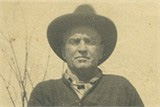
James Leard Shannon
(ancestry.com bulletin board) -
Dr. William Alexander "Murder Witness" Shannon, b. 1823 Pocahontas, Hardeman County, Tennessee
- Robert Shannon, m. b. abt. 1861, Tennessee
"Angeline's oldest son George lived in TN until his death. Another son Robert was in Arkansas by 1880. He died in Muldrow I.T. in 1897. Her two daughters Mary and Lucinda married Dunn brothers and lived in MS until their death. In the early Angeline moved to Indian Territory with her son James L. and his family. She died in Wagoner, Ok in May, 1908.
— Mollie Shannon, 1/28/2013Military records from the National Archives (NARA M231, Roll 39) confirm John A. Shannon’s placement in Company I, 14th Tennessee Infantry. While no specific date of death is recorded in the surviving muster rolls, the 14th Tennessee’s history provides a likely silhouette of his final years. The regiment was the first to engage at Gettysburg on July 1, 1863, and the last to retreat from the stone wall at The Angle on July 3. John’s absence from the 1870 Census and his son’s later attribution of a "William E. Shannon" as a father figure suggests John was among the many 14th Tennessee fatalities whose remains were never formally identified.
Tippah County, Mississippi, Circuit Court Records, Case 3022: Thomas J. Davidson v. John A. Shannon and Moses Shannon, March Term, 1849
John Shannon bought land from Levi Early, with witnesses recorded as James Little (father-in-law of Moses Shannon of Tippah County MS), F. M. Null, and S.W. Shannon (probably Swain Shannon).
McNairy County, Tennessee, Loose Records Case #1208, 1909
"[These records] establish that Angeline and Mary E. (Elizabeth) Shannon were daughters of John Null... In 1886 John Null died. John D. Null [brother to Mary E. and Angeline] continued to farm the land owned by their father. But when John D. Null himself died in 1908 this court case #1208 comes up for the purpose of dividing up the undivided land of old man Null (d.1886). On page 3 you see Angeline and Alex Shannon are mentioned.
1850 Federal Census, Tippah County, Mississippi, page 510a, house number 264
Various interpretations of the original script of this census place John Alexander Shannon performing labor for a Rossen, Rosson, or Rozen household. John Alexander's future in-laws were Rossen.
-
James M Rosen, m. age 39, b. NC
Elizabeth Rosen, f. age 29, b. TN
Elizabeth J Rosen, f. age 11, b. TN
Betha P Rosen, f. age 9, b. TN
William S Rosen, m. age 7, b. TN
Ann O Rosen, f. age 1, b. MS
Alexander Shannon, m. age 23, b. TN
1860 Federal Census, McNairy County, Tennessee, page 16, house number 108
-
Jno Shannon, m. age 37, b. TN
Angeline Shannon, f. age 30, b. TN
George Shannon, m. age 9, b. TN
Mary Shannon, f. age 7, b. TN
Alexandra Shannon, m. age 4, b. TN
Lucinda Shannon, f. age 2, b. TN
Alford Shannon, m. age 1, b. TN
1870 Federal Census, McNairy County, Tennessee, page 7, house number 64
In 1870 Angeline lived next door to her brother, Francis J. Null. Angeline's father, John Null, and her sister, Mary Null Shannon, lived in nearby households.
-
Angeline Shannon, f. age 40, b. TN
George Shannon, m. age 18, b. TN
Mary Shannon, f. age 16, b. TN
Alexander Shannon, m. age 14, b. TN
Lucinda Shannon, f. age 13, b. TN
James A. Shannon, m. age 11, b. TN
Robert Shannon, m. age 9, b. TN
1880 Federal Census, Blackland, Prentiss County, Mississippi, house number 208
This census records Angeline as head of household living with her two youngest sons, James and Robert.
-
Angeline Shannon, f. age 48, b. TN
James A. Shannon, m. age 21, b. TN
Robert Shannon, m. age 19, b. TN
James Shannon
b. abt. 1832, TennesseeJames Shannon appears in the 1850 census for Tippah County, Mississippi, on page 579a, student in the household of Joseph Hicks, 48 b. NC, husband to Jemima, 46 b. NC.
Shannon Generation 3 cont.
John "The Absent" Shannon *
b. early 1790s
d. betw. 1830 and 1840
+ Patsey Cockerham, daughter of Willian and Nancy (Estis) Cockerham
d. aft. 1860
- Jeremiah Shannon
- Joseph Shannon
- John C. Shannon
John "The Absent" Shannon was mentioned in 1815, when his father's estate was executed.
Theory, unproved: John "the Absent" Shannon was the "Jno Shannon," who along with his brother William "Of Richmond" Shannon, their uncle Owen "Old 300" Shannon, and other members of the Red River Settlement, signed the 1821 Territorial Petition to Congress in protest of the United States treaty with the Choctaw Indians.
- It explains the "Absenteeism": It gives John the Absent and William of Richmond a specific place to be (Pecan Point) when they were "missing" from the eastern records.
- It respects the "Head of Household" tradition: It suggests the nephews were there as independent men looking for their own land, while Owen’s son might have still been considered part of Owen's primary household/claim.
- It aligns with the horse-theft "Syndicate" theory: It shows the family moving as a multi-generational tactical unit (uncles and nephews) rather than just a single nuclear family.
John Shannon appears in tax lists for the years 1821-1830 for Miller and Crawford Counties, Arkansas Territory. He also appears in the 1830 Federal Census for Miller County, Arkansas Territory.
1830 Census Record, Miller County, Arkansas Territory:
1 male 30-39 (John), 1 male 15-19 (Jeremiah), 1 male 10-14 (Joseph), 1 male under 5; 1 female 30-39 (Patsey Cockerham), 2 females 10-14, and 1 female 5-9.
The need to move out of the Red River settlements, due to the Treaty of Doak's Stand, signed October 1820, was not a single event but a decade of legal and physical pressure. Initially, the U.S. government was slow to enforce the removal because of intense protest from the Red River Settlements. Their 1821 petition part of this effort to stall the process. The 1824 Treaty with the Choctaw clarified the boundary lines in that region. By 1825, the U.S. Army began actively ordering "squatters" to vacate. After the Treaty of May 1828 with the Western Cherokee, the pressure to move into established counties like Crawford or Sevier became a necessity to avoid total forfeiture of property.
It is highly probable that John the Absent bought property in Crawford County, Arkansas in preparation for the move north away from the Red River. If John purchased or "pre-empted" a claim in Crawford County in the late 1820s, he would appear on the tax rolls there as soon as the claim was registered, regardless of where he was sleeping. The 1830 census taker found him in Miller County because his family and "improvements" (crops, cabins, and heavy equipment) were likely still at the Red River site, squeezing out the last possible value before the final abandonment.
John's death date is undocumented. Pecan Point shifted between being part of Miller County (Arkansas Territory) and various Mexican jurisdictions. Many deaths in this "No Man's Land" were never recorded in a formal civil ledger. If his death was indeed "triggered by conflict" (i.e., a homicide or skirmish), it is less likely to have a formal church burial record and more likely to appear in a court "inquisition" or a stray mention in an equity court case regarding his father's estate back in the Pendleton District.
John "The Absent" Shannon may have been involved with the family horse theft syndicate that operated between Tennessee and the U.S. Mexican border. His death in Arkansas Territory in the 1830s may have been triggered by conflict in the wider family crime syndicate — as was the death of his brother, Moses P. Shannon.
After John's death, Patsey was remarried to a man named John George. The 1840 census of Crawford County, Arkansas, lists the John George household in Mountain Township, the area with John the Absent's tax levied land. Mountain Township, as the location of the John George household in the 1840 census is noteworthy. While Van Buren was the river port/seat, Mountain Township (north of Van Buren) was often the destination for those moving livestock or looking for the "hill country" terrain similar to the Pendleton District.
The 1840 census record, Crawford County, Arkansas:
1 male 40-49 (John George), 2 males 20-29 (Jeremiah and Joseph Shannon), 1 male 15-19 (John C. Shannon), 1 male 5-9, 1 female 40-49 (Patsey Cockerham Shannon George), 2 females 15-19, 1 female 10-14.
The presence of these specific young men in John George's household in Crawford County strongly supports a theory that John the Absent died in the early 1830s, and Patsey moved the family north to the property that John had already established and had been taxed.
Shannon Generation 4
Jeremiah Shannon
b. 1805-1808
d. unknown
+ Sarah
By the late 1820s, Jeremiah Shannon began appearing in the Miller County, Arkansas Territory, tax lists (1827-1829), as he reached the age of majority. Jeremiah is consistently listed in proximity to John "the Absent" Shannon. In 19th century ledgers, names were often grouped by neighborhood or family unit, showing John as the elder property owner and Jeremiah as the younger poll-tax payer.
By 1840, Jeremiah had established his own household in Crawford County, Arkansas: Lee's Creek Township (Census Division: Jasper Township), listed as Jeremiah Shannon, born approximately 1816 in South Carolina. He appears with his wife, Sarah, and children. This record is significant because it shows him remaining in the Crawford County area near the land his father, John "the Absent" began to develop.
By 1850, Jeremiah is no longer listed in the census record for Crawford County, Arkansas. He could have moved to Texas or another state — or returned to the Red River area to reclaim land originally associated with Wavell's Red River Colony (titles there were being litigated or formalized under new state laws as early as 1870). Jeremiah could have also joined the 1849 gold rush to California. No documentation of his later life has been found.
Joseph Shannon
b. 1812-1815
d. early 1880s
+ Elizabeth
By 1860, a Joseph Shannon (born c. 1812-1815) appears in Travis County, Texas. This is significant for several reasons:
- The Family Cluster: This Joseph Shannon is associated with Elizabeth Watkins Shannon, who was the widow of David Wilburn Shannon. This branch of the family originated in Washington County, Arkansas, and moved through Newton County, Missouri—both frequent stops for the "Pendleton" Shannons on their way west.
- Birthplace Alignment: This Joseph fits the age bracket of the "male 10-14" from the 1830 Miller County census.
- The "Syndicate" Logic: Travis County (Austin area) was a hub for frontier families transitioning from the Red River settlements into the central Texas hill country.
By the late 1860s and 1870s, Pulaski County (specifically the areas around Little Rock and Pennington's Mills) became a primary hub for the Pendleton Shannons:
- Moses "The Miller" Shannon: Your notes indicate that Moses Shannon (Joseph's brother or close cousin) was appointed Postmaster of Pennington's Mills in Pulaski County in 1867 and died there in 1870.
- Joseph's younger brother, John C. Shannon, also lived in Pulaski and Drew counties in Arkansas during this same window of time.
- Intriguingly, genealogical fragments from the region mention Elizabeth Shannon (widow of a Joseph Shannon) buried in the Preece Cemetery near Austin, Arkansas (then part of Pulaski/Lonoke). This Joseph is often linked to the Watkins family, who migrated from Kentucky through Washington County, Arkansas—a path frequently crossed by the "Absent" branch.
1880 Census, Joseph Shannon in Caroline Township, Lonoke County, Arkansas:
- This location is just east of where Moses "The Miller" Shannon served as postmaster.
- Lonoke County was formed in 1873 from parts of Pulaski and Prairie Counties.
Joseph Shannon, b. abt. 1815 Arkansas Territory, father's birthplace: South Carolina (consistent with John the Absent Shannon's origins); mother's birthplace: South Carolina (consistent with Patsey Cockerham's origins )
This Joseph Shannon is likely the husband of the Elizabeth Shannon buried in the Preece Cemetery.
After 1880, Joseph's name disappears from the primary tax rolls, which suggests he likely died in the early 1880s.
Joseph's return to the Pulaski/Lonoke area after the 1840s suggests that the John "the Absent" branch maintained a very different trajectory than the Texas-bound Owen "Old 300" Shannon branch. While Owen's descendants were deep in the Texas Revolution and land grants, John's sons — Jeremiah, Joseph, and John C. — seemed to focus on the Arkansas-Mississippi-Tennessee corridor.
There are several George family members (descendants of John George) living in the same townships as Joseph Shannon in 1880. This proximity suggests that even after moving from Crawford County, the blended families maintained their social and economic ties.
John C. Shannon
b. 1816, South Carolina
d. 1896
67/67 marker matches:
DNA test kits #165226, #2989, and #197182 to each other
The test kit comes from a descendant of John C. Shannon > William M. Shannon b. 1844 MS > Joshua Hendly Shannon b. 1880 AR > J.C. Douglas Shannon b. 1913 TX.
Hypothesis, unconfirmed
This DNA test kit — with data for Patsey and John C. Shannon — has been placed in the Shannon tree under John "The Absent" Shannon through reasoning based on:
- Likely proximity to the two strongly matched Shannon line DNA test kits 2989 and 65226
- Strong evidence that connects back to the Shannons of Pendleton District, South Carolina
- A process that eliminates other placements in the Shannon tree
The argument for placing John C. Shannon under John "The Absent" Shannon
- The pension application for John C. Shannon's son, William Shannon, states states that William was born in Winston County, Mississippi.
- The 'Deed of Gift' from John C. Shannon to his mother, Patsey, wife of John George. This proves that John C. Shannon was not the son of either Aaron or Moses Shannon since we know the names of their wives. No was John C. Shannon the son of William "Of Richmond" Shannon, whose family is documented in Georgia.
- The 1800 census from Pendelton District, South Carolina, shows a John George as a neighbor to a Nancy Chambers which indicates (but obviously does not prove) a long term association between these families.
- John C. Shannon is closely associated with James Chambers and William K. Chambers (who we can surmise is the son of James and Mary (Kilpatrick) Chambers) in both Winston County, Mississippi, and in Pickens County, Alabama.
- John C. Shannon lived near Aaron Shannon in Pickens County, Alabama, and bought land not too far from where Thomas Shannon had bought land.
What's Documented for John C. Shannon
DNA test kit analysis has revealed very close (3rd-4th cousin) matches between Shannons and a descendant of James Chambers of Winston Count, Mississippi. The only way that could possibly have happened is if John C. Shannon's first wife, Elizabeth, was in fact the daughter of James Chambers. (17)
Federal census records track these residences for John C. Shannon: 1830, Pickens County, Alabama (very near to household of Aaron Shannon); 1840, Winston County, Mississippi; 1860, Drew County, Arkansas; 1870, Pulsaski County, Arkansas; 1880, Drew County, Arkansas.
John C. Shannon's deed of gift from Winston County and Attala County, Mississippi, proves that his mother Patsey was alive at least until the 1860 census. (18)
John C. Shannon and wife Elizabeth first born son (name unknown) who died before 1850 and a subsequent son named William Kilpatrick Chambers Shannon. (18)
Interpretation
"My John C. Shannon seems to have been an only child. The 1860 census has him and his family living in his mother's house... I have him giving his mother slaves as gifts, I have him living with her, and later I have him migrating into AR and TX with no close relatives. They seem to be very inter-dependent on one another, except, I suspect, for members of her family. I have a number of families that John seems to associate with over a long period of time — Chambers, Nash, Crossley, McClanahan, Portwood, Kilpatrick — who I think are her relations in some way. Interestingly, there is a Null family that is near him in Winston county and later in Attala County. It has to be more than a coincidence that this Null family went in the same directions as two Shannon lines. It would seem to imply a kinship between their women folk. The Nulls also appear in Pendleton District SC in t he earlier censuses.
"I think it is most likely that John ["The Absent"] died some where on the frontier at an early age leaving a widow and young son. She might have remarried or simply went to live with relatives until marrying John George late in life.... for the most part, my John C. seems to have gone out of his way to keep his distance from the other Shannons (at his mother's influence?). I am convinced that most of the people he associates with in the 1840s and 1850s, after leaving Pickens County AL are his mother's relations. I think even the Chambers family that he... married into was related in some way to Patsey. His closest Shannon contact appears to have been his uncle Aaron ["Baylor Bear"] who was in Texas by 1840 or so. Aaron Shannon appears to have been unaffected by whatever was going on [horse theft], married into the Brandon/Kilpatrick family as did his nephew John C through the Chambers family. It just strikes me that John C. Shannon was raised in a fairly stable, amiable, refined sort of enviroment, and not the son of an outlaw/horsethief. Although, anything is possible."
— Stan Shannon (18)
+ Elizabeth Chambers, b. 1823, South Carolina, daughter of James Chambers and Mary Kilpatrick
- William Kilpatrick Shannon, b. abt. 1845 Mississippi
- James A. Shannon b. abt. 1847 Mississippi
- Mary J. Shannon b. abt. 1849 Mississippi
John C. Shannon appears in the 1850 census Winston County, Mississippi, in close proximity to the Chambers and Kilpatrick families.
By 1860, John C. Shannon completed his move to Arkansas, where he is listed in Drew County. During this period, he executed a "Deed of Gift" to his mother, Patsey George, which confirms she was still living at that time.
By 1870, he relocated to Pulaski County by 1870, placing him near other "Pendleton" Shannon family members, including Moses "The Miller" Shannon, who was a postmaster in the county until his death in 1870.
He appears to have returned to Drew County, where he is enumerated in the 1880 census.
Shannon Generation 3 cont.
William "Of Richmond" Shannon *
b. 1795
d. 1836, Augusta, Georgia
+ unknown
- John Shannon
- William Shannon
- Aaron A. Shannon
- Andrew S. Shannon
Hypothesis, unproved: William "Of Richmond" Shannon was the William Shannon, who along with his brother John "the Absent" Shannon, their uncle Owen "Old 300" Shannon, and other members of the Red River Settlement, signed the 1821 Territorial Petition to Congress in protest of the United States treaty with the Choctaw Indians.
It is possible that William's absence from Georgia at the time of the 1830 Federal census corresponds with his involvement with the family horse theft syndicate. Furthermore, his death in Georgia in 1836 may have been a murder related to that syndicate. This, however, is speculation.
"William was buried in Magnolia Cemetery in Augusta, Georgia. Because Williams' sons were all underage at the time of Williams' death, the estate was managed by a trustee, William's brother, Aaron Shannon of Tuscaloosa, Alabama... [Youngest son] Andrew... appears to have died in 1839, but the other three went on to be successful men, a lawyer, a merchant and a clerk... None of them ever married — no indication of children on any census."
— Stanley Shannon, March 17, 2017
1820 Federal Census, Richmond County, Georgia
- Wm Shannon, m. age 16-26
Aaron "Baylor Bear" Shannon *
b. June 8, 1796, South Carolina
d. July 25, 1865
+ Elizabeth Kirkpatrick, 1818, South Carolina
- John Shannon, b. 1820, South Carolina
- Clarissa Shannon, b. 1821, Pickens County, Alabama
- Sarah R M D Shannon, b. 1826, Pickens County, Alabama
- William Alexander "Of Grimes" Shannon, b. 1828, Pickens County, Alabama, lived in Grimes County, Texas
- Thomas Brandon Shannon, b. 1827, Pickens County, Alabama
- Aaron Shannon Jr., b. 1838
- Mary Elizabeth Shannon, b. 1841, Pickens County, Alabama
Aaron Shannon lived in Pickens County, Alabama, from 1820 to early 1841, when he moved his family to the Montgomery/Grimes County area of Texas. Shannon's grant of land there, dated July 2, 1841, is on record in the General Land Office, Austin, Texas.
Aaron Shannon was devoted to better education.
Aaron served for 20 years as one of the original fifteen trustees of Baylor University at Independence, Texas. Prior to that Shannon had served on the Board of Regents of the University of Alabama.
Aaron Shannon served in the War of 1812.
Private, Nash's Regiment, South Carolina Volunteers. He was commissioned a colonel in the army by President Andrew Jackson.
Aaron Shannon was a witness to the will of William Perkins, March 29, 1816, Pendleton District, South Carolina. (33)
Moses P. (Perkins) "The Thief" Shannon *
b. 1794 - 1799
d. 1834 Center Point, Sevier County, Arkansas Territory (now part of Howard County, Arkansas) (murder)
Murdered by Rivals
+ Jemima Cleveland Apr. 28, 1816, Franklin County, Georgia
b. abt. 1797
d. abt. 1901
- Martha Anne Shannon
- Eldest Son *
- Margaret Shannon *
- Aaron "Of Howard" Shannon *
- William P. Shannon / Bryant *
- Three additional daughters, for whom little is known.
* raised after 1834 in the Micajeh Bryant household.
Jemima Cleveland was daughter of Absalom Cleveland and Patty Harrison. Absalom was son of Col. Benjamin Cleveland. They were kin to President Grover Cleveland.
Immediately after the murder of Moses, Jemima is said to "have gone missing." Later, on Oct. 10, 1839, in Benton County, Arkansas, Jemima Cleveland Shannon was married to Wilton Brown.
The 1860 census for Sulphur Sping, Polk County, Arkansas, lists Jemima as Jemima Leeper (age 63). She was living in the household of her daughter Martha (age 40) and son-in-law, James Monroe Leeper (age 35). (40)
Jemima Cleveland Shannon Brown's will was probated July 8, 1901, in Franklin County, Georgia.
Connection to Bryant Surname: Moses Shannon's sister-in-law (Jemima's sister), Lucy Cleveland, was married to Micajah Bryant. Their household acquired children of Moses and Jemima, after Moses was murdered in 1834.
The 1840 census of Coffee County, Tennessee, lists the Micajeh Bryant household with:
- 1 male age 5-9 (William P. Bryant, perfect match, b. abt. 1832. DNA results confirm he is a biological Shannon)
- 1 male 10-14 (Matches Aaron "Of Howard" Shannon, youngest son in 1830 census; b. 1828, he would be exactly 12 years old.)
- 1 male age 15-19: The oldest son from the 1830 census (hypothesized as John), born c. 1821–1825.
- 1 female age 10-14 (Margaret Shannon, named after her aunt).
- 2 females age 5-9 (They possibly match the younger females in Moses Shannon's 1830 household.)
These children, assumed to have been dispersed from Moses's household, are older than what seem to be Micajah and Lucy's biological children (2 males under 5, 2 females under 5).
"My mother-in-law, Anne Bryant Smith, who passed away April 16, 2016, had worked out the great mystery of the parents of William P. Bryant. A male cousin with the Bryant surname did Y-DNA test, and it determined the link was SHANNON and not BRYANT. Now that autosomal is available and several people have tested the link shows that my husband's family are SHANNON. Several Shannon trees mention several children born to Moses Shannon and Jemima Cleveland. It appears that after Moses' death children were dispersed to either children's homes or relatives. Jemima's sister, Lucy who was married to Micajah Bryant, may have taken a male child whom several trees mentions goes missing." — Wanda Lee, Feb. 14, 2018
Moses Shannons served in the War of 1812.
Private, Nash's Regiment, South Carolina Volunteers. (45)
Moses lived in Pickens County, Alabama, in the 1820s, documented there along with his brothers Owen and Thomas by court dockets. However, it seems Moses retained ownership of, if not residnecy on, land in Pickens County (created from Pendleton District, 1826), South Carolina.
On Aug. 10, 1829, James R. Wyley bought land in Pickens County, South Carolina, "adjacent to land of Moses Shannon.... Being the same that Moses Shannan bid off at sale of property of the estate of Absalom Cleveland, deceased."
—genforum/cleveland post 1761
Sell off of inherited lands:
Land records from Pickens County, South Carolina... describe Owen, Thomas and Aaron of Pickens County, Alabama, selling their share of John Shannon's estate to Moses Shannon of Monroe County, Tennessee, in 1830.
— Stan Shannon, 6/24/2009
Historic references, 1846 transaction:
Deed from Book 3, pages 288-89 OBADIAH FOWLER TO ABSALOM HYDE (1846) 296 acres on Choestoe Creek South Carolina Pickens District KNOW ALL MEN BY THESE PRESENTS THAT I Obadiah Fowler of the State and District aforesaid for and in consideration of the sum of two hundred Dollars to me paid in hand by Absalom Hyde of the State and District aforesaid have granted, bargained, sold and released and by these presents do grant, bargain sell and release unto the said Absalom Hyde a certain tract or parcel of land situated in said District on the waters of Choestoe Creek waters of Tugalo River containing two hundred and ninety six acres more or less, part being granted to Thos. Fullerton by John Shannon beginning at a hickory N. 85 E.12 to a pine, thence N. 66 E. 20 to a pine thence N. 38 E. 38 to a post oak thence N. 10 E. 19 chains to a P.O. thence N. 79 W. 18 chains & 25 links to a poplar thence S. 5 W. 34 to a Hickory thence S. 20 E. to the beginning. The other part being granted by Moses Shannon to Thos. Fullerton bounded by Wm Mcombs & South by Burrel Jones land adjoining the above named tract. TOGETHER with all and singular the rights, members, and appertainances to the said premises belonging or in anywise incident or appertaining. TO HAVE AND TO HOLD all and singular the said premises unto the said Absalom Hyde his heirs & assigns forever against myself & my heirs and against every other person lawfully claiming the same or any part thereof. In witness wthereof I have hereunto set my hand and seal this 28th day of August A.D. 1846 Signed, sealed and delivered in the presence of the undersigned.
— T.W. Harbin Isaac Minton
For full details of United States vs Moses P. Shannon, 1833 circuit court term, legacy Miller County, Arkansas Territory, contact this website for access to drafts of his book soon to be published via his indy press, Riparia.US.
When it comes to who corrupted Moses Shannon...
"My theory is that it was most likely a combintion of his [Moses'] wife Jemima whining about him not caring for her and his kids the way her wealthy Cleveland family had, and his uncle Owen's possible ties to the likes of the Yoakums. Somehow the other Shannons, Owen and Thomas became involved with it, and had to flee out of the country to Texas under assumed names where they might have ended up being killed in the Texas Revolution. Although the fact that your Carters [William Levi Carter] end up also as hourse thieves is very interesting. That does seem like a intricate web of connections. But my money is on Owen, the elder's [Owen "The Old 300"], influence as to how it all got started. I think he was most likely the original point of contact with this apparent early day horse stealing syndicate."
— Stan Shannon, 12/24/2012
Shannon Generation 4
Martha Anne Shannon *
b. 1810 in South Carolina,
d.
+ James Monroe Leeper, Jan. 12, 1842, Hempstead County, Arkansas.
In the 1860 Census for Sulphur Spring, Polk County, Arkansas, Martha (age 40) is living with her husband James Monroe Leeper (age 35). Notably, her mother, Jemima Cleveland Shannon Brown (listed as Jemima Leeper, age 63), was living in their household at the time.
Eldest Son
b. 1820-25
This son, often hypothesized as a "John" by researchers, represents the oldest son of Moses and the oldest orphan passed on to the Micajah Bryant household; he could have followed his brother William P. to Winston County, Mississippi, but unlike his cousin John C. Shannon, also in Winston, the hypothesized John left no independent land or census trail. He may have died young or remained a landless member of the family cluster.
Margaret Shannon
b. 1826-1828
Raised after 1834 in the Micajeh Bryant household.
Aaron "Of Howard" Shannon *
b. March 21, 1828, Tennessee
d. June 17, 1900, buried Bean-Coulter Cemetery, Center Point, Howard County, Arkansas
+ Sarah A. John, July 17, 1855, Hempstead County, Arkansas (19)
b. abt. 1838
- Frances Elizabeth Shannon, b. 1858, married Archie Turrentine of Arkadelphia, Arkansas; their children: Percy Turrentine, professor at Henderson State University, Arkadelphia, Arkansas, where a dormitory is named after him, and Hugh Turrentine, a physician in North Little Rock, Arkansas.
- William D. Shannon, b. abt. 1861
- James A. Shannon, b. abt. 1864, married Laura Jane "Horn" Choate; oldest son: Hal E. Shannon whose daughter, Jimmie Nell Shannon, married Homer Bradshaw.
- David R. Shannon, b. abt. 1868
- Etta Shannon, b. abt. 1873
- Charles E. Shannon, b. abt. 1876
- Sallie R. Shannon, b. abt. 1879
"I am the granddaughter of Hal E Shannon. Jimmie Bradshaw is my dad's sister (my aunt). Just wanted to tell you I find your information very interesting, I have been to the Bean-Coulter Cemetery several times outside of Center Point and wondered how Aaron came from SC. My grandfather and I went to Sally's funeral when I was a young girl, and he said she was the last of the older Shannon's; I think she was his aunt."
— Shirley Shannon Taylor, Feb. 2, 2011
After his father's murder and his mother's disappearance in 1834, Aaron was sent to the houserhold of Micajeh Bryant. The census of 1840 indicates that Aaron was still there at that time. Howver, by 1842 Aaron's guardian was Cornelius Stewart of Sevier County, Arkansas.
"Sevier County, Arkansas, Probate Court has entries in 1842 & again in 1845 regarding 'Cornelius Stewart guardianship of the heirs of Moses Shannon'."
— Charline Rambaud, Oct. 20, 2013
Aaron Shannon fought in the Mexican War. 1846-1848, as Private, part of Company G, Mtd Reg't Arkansas Infantry. Aaron applied for a Mexican War pension in 1887; that record places his service in Company G, 1st Arkansas Cavalry. Aaron's widow assumed that pension in 1900. (42-44)
1850 Federal Census, Blue Bayou Township, Sevier County, Arkansas, household 448
Aaron appears in this census as overseer on the farm of Mathew Coulter. Shannon-Coulter family alliances extend at least as far back to Giles County, Tennessee, where Coulter was married into Quinton Shannon's line. James Turrentine, head of the adjacent household in 1850, would become an in-law to Aaron, through Aaron's eldest daughter.
- Matthew Coulter, m. age 29 b. MS
Sarah Coulter, f. age 20, b. AR
Daniel Coulter, m. age 2, b. AR
John Coulter, m. age 1, b. AR
Nancy Coulter, f. age 71, b. NC
Aron Shannon, m. age 22, b. TN
1860 Federal Census, Blue Bayou Township, Sevier County, Arkansas, household 490
Aaron Shannon's neighbors were James Coulter (household 486) and E. M. Thornton (household 497), a widow.
- Aaron Shannon, m. age 31, b. GA
Sarah A. Shannon, f. age 22, b. GA
Frances E. Shannon, f. age 1, b. AR
1870 Federal Census, Blue Bayou Township, Sevier County, Arkansas
- Aaron Shannon, m. age 41, b. TN
Sarah Shannon, f. age 33, b. GA
Frances E. Shannon, f. age 11, b. AR William D. Shannon, m. 9, b. AR
James A. Shannon, m 9. B. AR
David R. Shannon, m 2, b. AR
1900 Federal Census, Center Point and Madison Townships, Center Point town, Howard County, Arkansas, household 235, sheet 13A, line 9
- Aaron Shannon, head, m. age 72, b. TN
Sarah Shannon, wife, f. Age 64, b. GA
Etta Shannon, daughter, age 27, b. AR
Charles E. Shannon, son, age 24, b. AR
Sallie R. Shannon, daughter, age 21, b. AR
William Posey Shannon / Bryant
b. Dec. 25, 1828, Habersham, Georgia
d. Oct. 23, 1906, Charleston, Bradley County, Tennessee
37/37 marker matches:
From DNA test kit #74591 to test kits #154822, #2989, and #197182
+ Isabella Ann McCarty
b. 1833
d. 1862
- James Wellington Bryant, 17 December 1850 - 23 March 1888
- William McCarty Bryant, 20 March 1853 - 27 January 1937
- Timothy Edward Bryant, 27 May 1855 - 18 December 1939
- Amilda French Bryant, 7 October 1857 - 26 October 1889
- John Lee Bryant, 15 January 1860 - 22 February 1915
Biological Identity: The youngest son of Moses "The Thief" Shannon and Jemima Cleveland. He was approximately two years old when his father was murdered in Arkansas Territory in 1834.
The Bryant Adoption: Following the murder and the subsequent "disappearance" of his mother, William was taken in by his aunt and uncle, Micajah and Lucy (Cleveland) Bryant. He appears in their 1840 Coffee County, Tennessee household in the male 5–9 bracket, a perfect age match for his birth year.
DNA Proof: The connection to the "Pendleton" Shannons is no longer speculative. Y-DNA testing on a direct male descendant of William P. Bryant confirmed a match to the Shannon Y-chromosome, proving he was a biological Shannon raised under the Bryant surname.
Migration & Adult Life: Unlike his brother Aaron "Of Howard" Shannon, who returned to the Howard County area, William remained closely tied to the Bryant and Cleveland migration patterns. He eventually settled in Winston County, Mississippi, where he lived near his cousin John C. Shannon and other members of the "Syndicate" families.
Research Significance: William serves as the "smoking gun" for the theory that the Cleveland family (specifically Lucy Bryant and her mother Elizabeth) actively recovered and raised the orphans of the 1834 tragedy, preserving the lineage even while the children's surnames changed.
Shannon Generation 3 cont.
Margaret "Peggy" Shannon
+ Benjamin Holland
d. bef. Oct. 9, 1816
- Rutha Holland
- Polly Holland
- Thomas Holland
- Sally Holland
- John Shannon Holland
- Jacob Holland
Benjamin Holland's will, proven on Oct. 9, 1816, Pendleton District, South Carolina, mentions each of the six children noted above. (32)
Shannon Generation 1 cont.
William "Long Canes" Shannon *
+ unknown
- Quinton Shannon — hypothesis, unconfirmed
- David Shannon — hypothesis, unconfirmed
- William "Of Sevier" Shannon — hypothesis, unconfirmed
- Roseannah Shannon — hypothesis, unconfirmed
William Shannon settled in the Long Canes area of South Carolina in 1766 directly across the Savanna River from where Thomas Shannon settled in 1773.
"1767 is when we find the first record of Thomas in VA. My theory was that perhaps Thomas had originally intended to migrate directly to SC as William did, but perhaps his ship had to put in for some reason at a more northerly port and he had to work his way southward overland. There is also a Samuel Shannon who settles in the Belfast Township not far away in 1767."
— Stan Shannon, 7/17/2009
Shannon Generation 2
Quinton Shannon
b. bef. or abt. 1775, Georgia
+ unknown
b. bef. or abt. 1775
- Sally Shannon
- Rebecca Shannon
Georgia Land Grants
Quinton Shannon, 2 in family; present for Georgia Land Grants presentation July 2, 1798.
Quinton Shannon was listed in the early Elbert County, Georgia, deed books. Elbert and Lincoln Counties were formed from Wilkes County, Georgia.
Tennessee Land Grants
Quinton Shannon received two land grants in Giles County, Tennessee, per Tennessee Land Grants, Vol. II, Barbara, Byron and Samuel Sistler, 1998, pp. 312, 313:
- 1826, 60 acres, Mountain District Book 6, page 490, grant number 4919.
- 1828, 50 acres, Mountain District Book 9, page 536, grant number 7694
Giles County, Tennessee
Quinton Shannon is listed on the 1812 tax list of Giles County, Tennessee, which also listed William Shannon and David Shannon.
1820 Federal Census, Giles County, Tennessee, page 27
- 1 male age 45 and over
1 female < 10
1 female age 16-26
11 female age 45 and over
in agriculture
1 slave
David Shannon
David Shannon appears in the 1812 tax list of Giles County, Tennessee.
William "Of Sevier" Shannon *
b. 1770-1780
d. aft. 1832
Family Crime Syndicate: Suspect
William resided along the Red River, near Owen "The Old 300" Shannon, John "Pecan Point" Shannon, and Jacob Montgomery Shannon — all suspected criminals.
William Shannon appears in the 1812 tax list of Giles County, Tennessee.
He subsequently lived in Wavell's Red River Colony in the southwest corner of what then was Arkansas Territory (now northeast Texas). This was a formal Empresario grant. In 1826, the Mexican government granted Arthur G. Wavell (an English general) a contract to settle 400-500 families in this specific border region. Mexico wanted a "buffer" population to secure the border against U.S. encroachment and to formalize land ownership.
Many of the original Pecan Point settlers, including William "Of Sevier" Shannon, eventually registered as members of Wavell's Colony between 1826 and 1830 to secure legal title to the land they had already been occupying for years. Wavell's colony ultimately failed to fulfill its full contract because the Law of April 6, 1830, prohibited further immigration from the United States, effectively freezing the colony's growth.
"In the register of Arthur G. Wavell's Colony in Texas, which included this same area south of Red River, the name William Shannon appears, with wife Penelope (Ward), and children Polly, Francis Vigo, Levina, and Evelina. They are family 56, and the register covered years 1826-1830. William stated he arrived in the area June 19, 1818. This date is within a year or so of... Owen Shannon's arrival in this same area." — Cleveleand genforum
By the 1830s William Shannon lived north of the Red River in Sevier County, Arkansas Territory.
This is the county where William's cousin, Moses P. Shannon, lived until his murder in 1834. And it's the county where Moses P. Shannon's son, Aaron Shannon, lived near Coulter families related to Henry Coulter, husband of Roseannah Shannon.
Tax records place William Shannon in Sevier County, Arkansas Territory, in 1828, 1830, and 1832.
1830 Federal census, Sevier County, Arkansas Territory, household of William Shannon, p. 163
- 1 male age 5-10
1 male age 50-60
1 female age <5
1 female age 10-15
1 female age 40-50
Roseannah Shannon
b. abt. 1760-1770
+ James P. Alexander
- Eliza R. Alexander, b. 1797 GA, married Henry N. Coulter 1821
James and Roseannah lived in Elbert County and Lincoln County, Georgia. By 1820 they settled in Madison County, Tennessee.
In 1823 two of James and Rosannah's sons die:
- Nathaniel Alexander, a Presbyterian minister dies while at Greeneville College in Greene County, Tennessee.
- William S. Alexander dies in Madison County, Tennessee.
"In 1829 James and Rosannah's son James Jr. (b. 1801 GA) marries Amelia Ann Conn. About 1830 James and Rosannah move to Graves Co KY, while James Jr and Amelia move to IL (near Coles Co or Bond Co ?). About 1832 James Jr and Amelia move near their parents and siblings in Graves Co. Both James Jr and James Sr die in Graves Co KY as well as Jane (Alexander) Guthrie, and Eliza R. (Alexander) Coulter. Rosannah may have died in Arkansas after 1843 with Alexander or Shannon relatives.
— Shannon genforum
Shannon Line Fragment, Thompson Surname
Male carrying Shannon Y-Chromosome
+ Mary Thompson
b. 1836, South Carolina (Race: Mulatto) (41)
daughter of Jack Thompson, b. abt. 1793 Georgia (Race: Black) (41)
-
Miles Thompson, b. 1854, South Carolina (Race: Mulatto) (41)
Miles was raised by his maternal grandfather, Jack Thompson
Additional children in the household of Jack Thompson in 1870:
- Thomas Thompson, b. 1858, South Carolina (Race: Mulatto) (41)
- Rebecca Thompson, b. 1861, South Carolina (Race: Mulatto) (41)
It is unknown which Shannon male was the father of Miles Thompson. According to DNA analysis shared by Byron Russell Shannon (1/29/2011), the Shannon-Thompson Y-chromosome marker matches may indicate a shared ancestor in the mid to early 1700s. If so, then the shared ancestor could be from multiple Shannon generations.
"...Most of this genealogy is word of mouth from [Lewis Thompson's] aunts in Virginia... However, he [Lewis] can trace back to Jack Thompson... who raised his ancestor, Miles... [who was] son of Mary Thompson... and listed as a mullatto on the 1870 census, living in Greenville county SC - which was the same Pendleton District [where] John Shannon and his sons had lived... some 40 years before, all of whom had migrated westward by 1820. But that apparently is where he gets the Shannon Y chromosome from..."
— Stan Shannon, 6/20/2009 and 8/8/2009"I believe Mary was born in 1836 according to the family tree page that Lewis compiled. He has an interesting story to tell that Mary was the product of a slave owner with a Shannon name, and his DNA shows that he is correct."
— Byron Russell Shannon, Jan. 29, 2011
Sources
- "Revolutionary Records of the State of Georgia, Vol. II...
- ...Georgia's Roster of the Revolution" by Lucian Lamar Knight
- "Early Records of Georgia Vol.I, Wilkes Co., Georgia" by Grace Gillam Davidson, p. 288 for Thomas Shannon
- Research of Stan Shannon
- http://trees.ancestry.com/tree/11614768/family?cfpid=776021988
- "Tennessee Marriage Records & Bonds, 1783-1870" Vol #3, by Silas E. Lucas Jr. 1981, Gertrude L. Soderberg 1965
- Texas Online Handbook: Pecan Point
- Texas Online Handbook: The Old 300
- Shannons of Montgomery County, Shannon genforum post 10/14/2009
- Little genforum post, 11/25/1998
- "Texas Deaths, 1890-1976," database with images, FamilySearch (https://familysearch.org/ark:/61903/1:1:K7DN-12S : 5 December 2014), Wm E Shannon in entry for James L Shannon, 09 Jun 1929; citing certificate number 29167, State Registrar Office, Austin; FHL microfilm 2,114,939.
- Records of Lewis Thompson
- "United States Census, 1880," database with images, FamilySearch (https://familysearch.org/ark:/61903/1:1:M4P9-WDV : 11 August 2016), C A Shannon, Blackland, Prentiss, Mississippi, United States; citing enumeration district ED 170, sheet 196A, NARA microfilm publication T9 (Washington D.C.: National Archives and Records Administration, n.d.), roll 0663; FHL microfilm 1,254,663.
- "United States Census, 1910," database with images, FamilySearch (https://familysearch.org/ark:/61903/1:1:MLWS-M1V : accessed 3 June 2017), James L Shannon, Canadian, Pittsburg, Oklahoma, United States; citing enumeration district (ED) ED 216, sheet 11A, family 199, NARA microfilm publication T624 (Washington D.C.: National Archives and Records Administration, 1982), roll 1269; FHL microfilm 1,375,282.
- "Find A Grave Index," database, FamilySearch (https://familysearch.org/ark:/61903/1:1:Q231-8P6S : 7 June 2016), James Leird Shannon, 1929; Burial, Skidmore, Bee, Texas, United States of America, Evergreen Cemetery; citing record ID 160431651, Find a Grave, http://www.findagrave.com.
- Notes from Mollie Shannon, 1/28/2013
- Notes from Stan Shannon, 1/25/2015
- Notes from Stan Shannon, 1/16/2013
- Arkansas Marriages, 1820-1840
- Wilkes County, Georgia, Tax Records, 1785-1805, Hudson, Frank Parker, Volume One
- Book, Marriage & Death Notices from the Pendleton South Carolina Messenger, 1807-1851, 973.725
- DAR Descendant Lists, DAR members #692755 and #882985
- "United States Census, 1940," database with images, FamilySearch (https://familysearch.org/ark:/61903/1:1:KMRH-67F : 16 March 2018), Gilbert Shannon in household of Wesley B Shannon, Artesia, Election Precinct 6 Artesia, Eddy, New Mexico, United States; citing enumeration district (ED) 8-16A, sheet 15B, line 69, family 325, Sixteenth Census of the United States, 1940, NARA digital publication T627. Records of the Bureau of the Census, 1790 - 2007, RG 29. Washington, D.C.: National Archives and Records Administration, 2012, roll 2444.
- "Find A Grave Index," database, FamilySearch (https://familysearch.org/ark:/61903/1:1:QV2P-RY7G : 13 December 2015), Gilbert Randall Shannon, 2002; Burial, Roswell, Chaves, New Mexico, United States of America, South Park Cemetery; citing record ID 79212471, Find a Grave, http://www.findagrave.com.
- Ancestry.com. Roster of Revoloutionary Soldiers in Georgia Vol. III [database on-line]. Provo, UT, USA: Ancestry.com Operations Inc, 2006. Original data: McCall, Mrs. Howard H., Roster of Revolutionary Soldiers in Georgia. Vol. III., Baltimore, MD, USA: Genealogical Publishing Co., 2004.
- "United States Census, 1790," database with images, FamilySearch (https://familysearch.org/ark:/61903/1:1:XHKF-BGT : accessed 16 October 2018), John Shannan, Pendleton, South Carolina, United States; citing p. 8, NARA microfilm publication M637, (Washington D.C.: National Archives and Records Administration, n.d.), roll 11; FHL microfilm 568,151.
- Biography of Thomas Shannon by James Edward Mitchell, Sons of American Revolution patriot profile.
- Georgia Roster of the Revolution, Containing a List of the State's Defenders; Officers and Men; Soldiers and Sailors; Partisans and Regulars; Whether Enlisted from Georgia or Settled in Georgia after the Close of Hostilities, Lucian Lamar Knight, Index Printing Company, Atlanta, Georgia, 1920, p. 155, 158, 228, 294, 391, 427, and 428.
- Pendleton District and Anderson County, S.C. Wills, Estates, Inventories, Tax Returns, and Census Records, Virginia Wood Alexander, Collen Morse Eliot, and Betty White, Southern Historical Press, Easeley, South Carolina, pp. 195.
- Ibid., p. 379.
- Ibid., p. 34.
- Ibid., p. 51.
- Ibid., p. 64.
- Index to the Headright and Bounty Grant of Georgia, 1756-1909, compiled by Silas Emmett Lucas, Jr., Vidalia, Georgia, published by Georgia Genealogical Reprints, 1970.
- The Wilkes County Papers, 1773-1833, a Compilation of the Genealogical Information Found in Collections of Loose Court, Estate, Land, School, Military, Marriage, and Other Records of the Ceded Lands and Wilkes County, Georgia, from 1773 to 1833, with a Few Additional Papers from Earlier and Later Periods, compiled by Robert Scott David, Jr., Southern Historical Press, Easeley, South Carolina, p. 184.
- Ibid., p. 268.
- Loyalists in the Southern Campaign of the Revolutionary War, Vol. III, Official Rolls of Loyalists Recruited from the Middle Atlantic Colonies, with Lists of Refugees from Other Colonies, Murtie June Clark. Genealogical Publishing Company, Baltimore. 1981. Title Page
- "United States Census, 1840." Scott County, Missouri, John Houk household. Database with images. FamilySearch. http://FamilySearch.org : 17 January 2020. Citing NARA microfilm publication M704. Washington, D.C.: National Archives and Records Administration, n.d.
- Email dated Jan. 14, 2015, from Annie West Larkin
- "United States Census, 1860", database with images, FamilySearch (https://familysearch.org/ark:/61903/1:1:M875-17J : 13 December 2017), Monroe Leeper, 1860.
- "United States Census, 1870", database with images, FamilySearch (https://familysearch.org/ark:/61903/1:1:M8RV-H65 : 13 June 2019), Mary Thompson in entry for Jack Thompson, 1870.
- "United States Mexican War Pension Index, 1887-1926", database with images, FamilySearch (https://familysearch.org/ark:/61903/1:1:K8HH-NFB : 3 October 2018), Aaron Shannon, 1887.
- "United States Mexican War Pension Index, 1887-1926", database with images, FamilySearch (https://familysearch.org/ark:/61903/1:1:K8HH-NF1 : 3 October 2018), Aaron Shannon, 1900.
- "United States Mexican War Index and Service Records, 1846-1848", database with images, FamilySearch (https://familysearch.org/ark:/61903/1:1:QLXQ-2XHL : 13 March 2018), Aaron Shannon, 1846-1848.
- United States War of 1812 Index to Service Records, 1812-1815, database with images, FamilySearch (https://familysearch.org/ark:/61903/1:1:Q29K-R4S9 : 12 March 2018), Moses Shannon, 1812-1815; citing NARA microfilm publication M602 (Washington, D.C.: National Archives and Records Administration, n.d.); roll 186; FHL microfilm 882,704.
- "Arkansas Confederate Pensions, 1901-1929", database with images, FamilySearch (https://familysearch.org/ark:/61903/1:1:76MN-RQ6Z : 4 November 2019), James A Shannon in entry for Mary Shannon, 1903.
- Strickland, Rex. "Miller County, Arkansas Territory, the Frontier that Men Forgot," Chronicles of Oklahoma. (Spring 1940).
- Strickland, Rex. "Establishment of Old Miller County, Arkansas Territory," The Chronicles of Oklahoma. (Summer 1940).
- Yates Publishing, U.S. and International Marriage Records, 1560-1900, (Name: Name: Ancestry.com Operations Inc; Location: Provo, UT, USA; Date:2004;;), Source number: 1766.021; Source type: Family group sheet, FGSE, listed as parents; Number of Pages: 1.
- Ancestry.com, SAR Application, (Name: Name: Online publication - Provo, UT, USA: Ancestry.com Operations,Inc., 2011.Original data - Sons of the American Revolution Membership Applications, 1889-1970. Louisville, Kentucky: National Society of the Sons of the American Revolution. Microfilm, 508 rolls;;), Volume: 287; SAR Membership Number: 57316.
* Nickname added herein to distinguish ancestors having the same first name, not used by these persons in historical context.